
How Direct & Indirect Taxation From Finance, Tax and Accounting Course Applies on the Job
 Hardik Gupta30 Jul, 2026
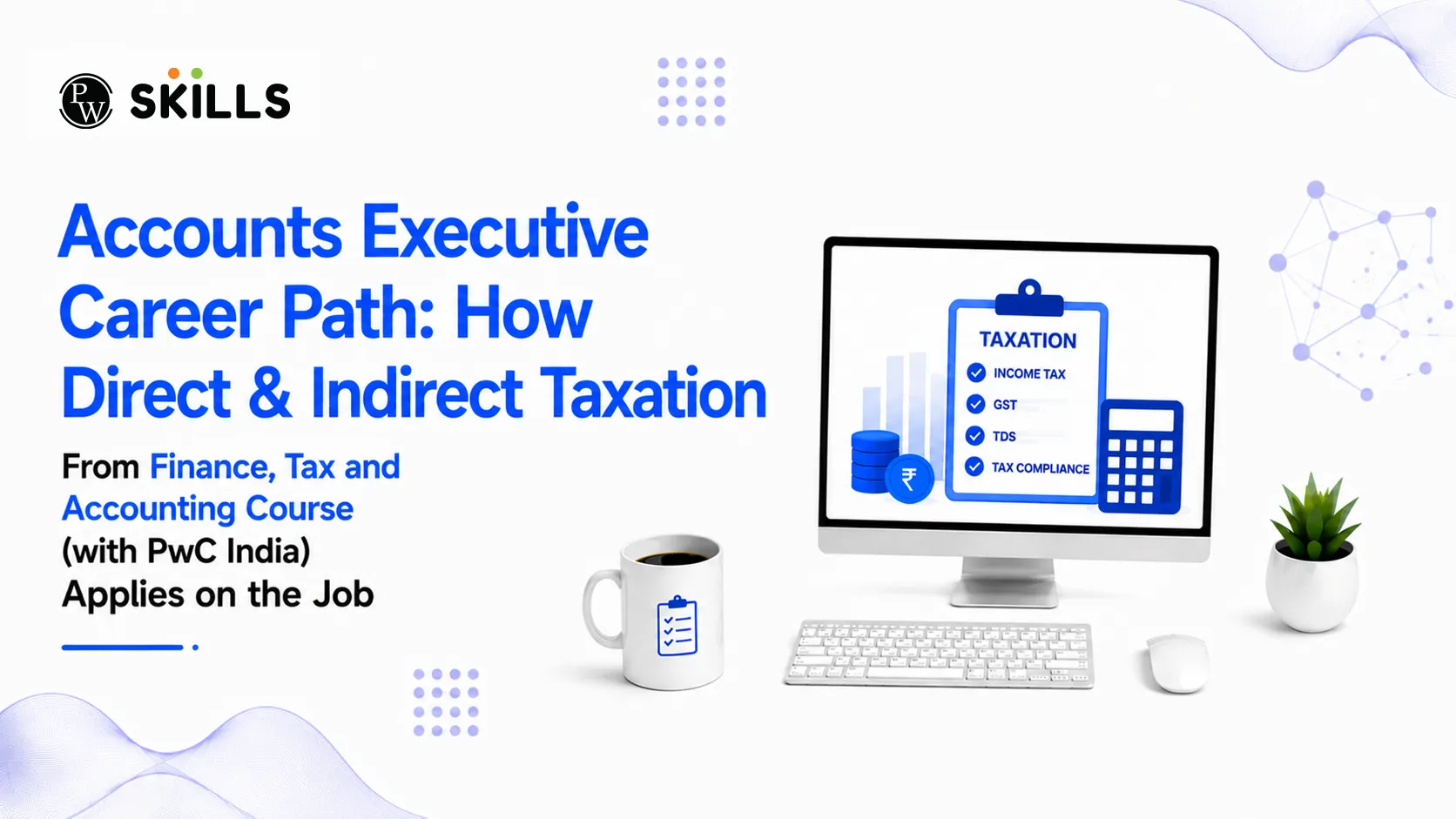
Strong accounting and taxation skills are essential for businesses to maintain accurate financial records and comply with changing regulations. An Accounts Executive plays an important role in managing daily ledgers, GST filings, direct taxation, and financial reporting. A Finance, Tax and Accounting Course (with PwC India) helps you develop practical expertise in accounting, taxation, compliance, and reporting, preparing you for high-growth opportunities in corporate finance and accounting.
What Does an Accounts Executive Do Daily?
An Accounts Executive handles the fundamental financial operations of an organization. Their primary goal is to maintain accurate accounting records, ensure timely tax payments, and generate regular financial statements for internal stakeholders
┌─────────────────────────────────────────────────────────┐
│ Accounts Executive Daily Focus │
├───────────────────────────┬─────────────────────────────┤
│ Financial Operations │ Tax Compliance & Audit │
├───────────────────────────┼─────────────────────────────┤
│ • General Ledger Entries │ • GST Return Preparation │
│ • Vendor Invoicing │ • TDS Calculation & Deduction│
│ • Bank Reconciliation │ • Monthly Ledger Audits │
└───────────────────────────┴─────────────────────────────┘
Responsibilities in Corporate Finance
On a standard workday, an Accounts Executive manages multiple accounting tasks across departments:
-
Bookkeeping and Ledger Maintenance: Recording routine income, expenses, and asset movements in ERP software.
-
Invoice Verification: Reviewing supplier bills to ensure proper line items, vendor details, and tax charges.
-
Bank Reconciliation: Matching internal ledger entries against bank statements to identify discrepancies.
-
Tax Deduction at Source (TDS): Calculating and deducting correct TDS rates before releasing payments to vendors.
Finance, Tax and Accounting Course (with PwC India) for Direct Taxation
Direct taxation refers to taxes paid directly by an individual or organization to the government, primarily Income Tax and Corporate Tax. Accounts Executives ensure these liabilities are computed and deposited accurately.
|
Direct Tax Activity |
Functional Objective |
Operational Frequency |
|
TDS Computation |
Deducting applicable tax on salaries, professional fees, and rent. |
Daily / Monthly |
|
Advance Tax Deposit |
Estimating quarterly income and depositing tax installments. |
Quarterly |
|
Tax Audit Support |
Organizing financial documents and vouchers for external auditors. |
Annually |
Understanding direct taxation helps an executive prevent legal penalties and interest charges on delayed tax payments. Accurate ledger records simplify year-end tax return filings.
Finance, Tax and Accounting Course (with PwC India) for GST and Indirect Taxation
Indirect taxes are collected by businesses from customers on behalf of the tax authorities. In India, Goods and Services Tax (GST) forms the largest portion of indirect tax compliance.
Key Aspects of GST Compliance
Navigating Finance, Tax and Accounting Course (with PwC India) + GST compliance requires clear execution of statutory requirements:
-
Filing Monthly Returns: Preparing data for GSTR-1 (outward supplies) and GSTR-3B (summary return).
-
Input Tax Credit (ITC) Reconciliation: Cross-checking purchase registers with vendor filings to claim eligible credit.
-
E-Way Bill Generation: Creating transportation documentation for moving goods above specified value thresholds.
Failures in ITC matching lead to direct financial loss for the employer, making this a critical daily responsibility.
Why Choose Finance, Tax and Accounting Course
Academic degrees offer theoretical knowledge, but real-world accounting requires hands-on software fluency and current regulatory understanding. Up-skilling through targeted training bridges this industry gap.
Theory-Based Learning ──> Gap in Practical Execution ──> Specialized Training ──> Job Readiness
Enrolling in this course prepares aspiring candidates for real corporate scenarios. It moves beyond textbook definitions to cover practical ledger entries, complex reconciliations, and automated filing portals.
Career Impact of Specialized Upskilling
-
Industry-Relevant Curriculum: Exposure to modern tax workflows and accounting tools.
-
Faster Job Onboarding: Less reliance on entry-level training when joining an accounting team.
-
Clearer Promotion Pathways: Quick transition from basic entry tasks to advanced corporate reporting.
Finance, Tax and Accounting Course (with PwC India) for Accounts Executive Jobs
Securing competitive Finance, Tax and Accounting Course (with PwC India) + Accounts Executive Jobs depends on demonstrating applied skills to hiring managers during technical interviews.
Key Point: Employers prioritize candidates who understand practical tax portal mechanics over those who only memorize tax sections.
Skills Employers Test During Interviews
-
ERP Software Proficiency: Navigating accounting suites to pull trial balances and run ledgers.
-
Reconciliation Skills: Solving real discrepancies between purchase books and GSTR-2B data.
-
Statutory Knowledge: Knowing exact due dates for TDS payments, advance tax, and monthly GST filings.
Finance, Tax and Accounting Course for Direct vs Indirect Taxation
To understand how daily tasks divide between direct and indirect taxes, consider this practical breakdown:
Handling Direct Tax Tasks
-
Calculate TDS rates on vendor invoices using relevant tax sections.
-
Deposit deducted tax through official government tax portals before monthly due dates.
-
Issue quarterly TDS certificates to vendors for their tax filings.
Handling Indirect Tax Tasks
-
Verify GSTIN details on incoming vendor invoices.
-
Classify transactions under correct HSN and SAC codes.
-
Reconcile sales registers with electronic portals to ensure accurate tax collection reporting.
Finance, Tax and Accounting Course (with PwC India) Career Path
A career in corporate accounting offers predictable growth if you consistently update your technical and regulatory skill set.
Accounts Executive ──> Senior Accountant ──> Assistant Finance Manager ──> Finance Manager
Career Progression Stages
-
Entry Level (Accounts Executive): Focuses on voucher entry, basic reconciliations, and initial invoice processing.
-
Mid Level (Senior Accountant): Manages finalization of accounts, direct tax audit prep, and monthly GST filings.
-
Management Level (Finance Manager): Handles financial strategy, treasury management, and corporate risk mitigation.
Continuous learning through this course accelerates movement through these tiers by providing strong core competencies early on.
Finance, Tax and Accounting Course Skills Checklist
To ensure complete job readiness, maintain a functional checklist of skills to practice regularly:
-
[ ] Learn basic accounting principles and double-entry ledger bookkeeping.
-
[ ] Understand the practical mechanics of Finance, Tax and Accounting Course (with PwC India) + How statutory filings operate on government portals.
-
[ ] Practice monthly bank reconciliation statements using realistic spreadsheet data.
-
[ ] Learn the process of generating e-invoices and e-way bills for commercial dispatch.
-
[ ] Study recent regulatory updates regarding GST rates and TDS thresholds.



Taxation FAQs
What is the primary role of an Accounts Executive?
How does direct taxation differ from indirect taxation in daily work?
Is practical tax knowledge mandatory for entry-level accounting jobs?
How does a specialized accounting course help in career growth?
What software tools do Accounts Executives use regularly?





Get Free Counselling Today
and Clear up all your Doubts
 Live & recorded classes available at easeDashboard for progress trackingLakhs of practice questions

