
Investing vs Trading: Which Is Right for You?
 Hardik Gupta15 Jul, 2026
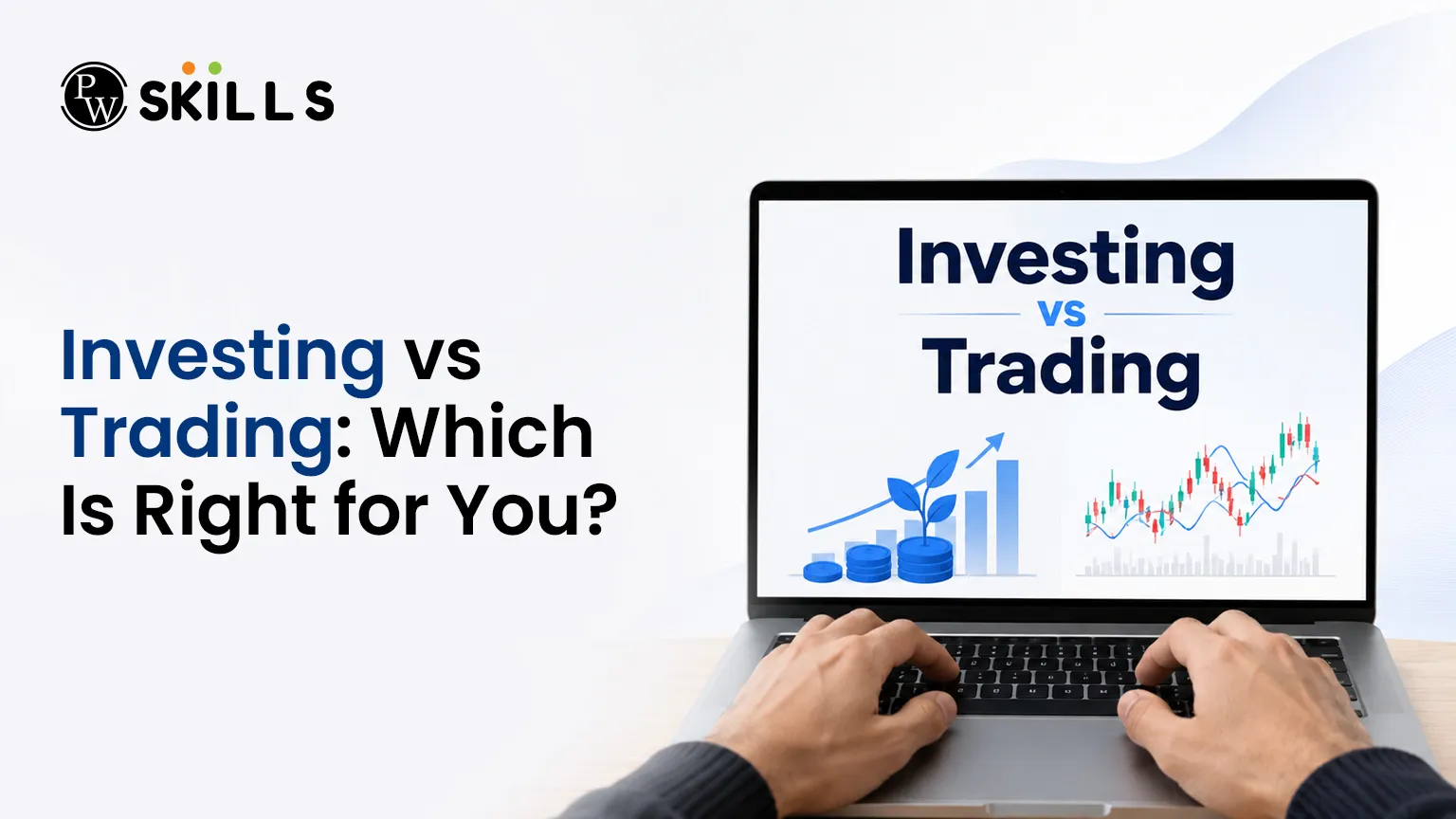
Choosing between Investing vs Trading can be challenging for beginners because both approaches offer unique opportunities to grow wealth. However, they differ significantly in terms of risk, time horizon, market analysis, and capital management.
Whether you want to build long-term wealth or actively participate in short-term market movements, understanding the difference between investing and trading is essential for making informed financial decisions.
What is Investing vs Trading?
To understand investing vs trading, you must look at how each approach interacts with the market over time. The fundamental distinction lies in the holding period and the underlying strategy used to generate returns. Investors generally look at the intrinsic value of an asset, aiming to buy and hold for extended periods. Traders, on the other hand, focus on market psychology and price trends to make frequent transactions.
The two methods also differ in their approach to market volatility. So when the market drops, investors see that as an opportunity to buy more assets at a discount. They believe that the market will recover over time. Volatility is an opportunity for swift price differentials, with traders often buying and selling over days, hours, or minutes.
Let’s take a brief look at how these two approaches stack up on key operational metrics:
|
Feature |
Investing |
Trading |
|
Time Horizon |
Long-term (Years or decades) |
Short-term (Minutes, days, or weeks) |
|
Primary Analysis |
Fundamental analysis |
Technical analysis |
|
Risk Profile |
Moderate to low over time |
High risk per transaction |
|
Capital Growth |
Compounding and dividends |
Frequent short-term profits |
|
Activity Level |
Passive management |
Active market monitoring |
How Does Investing Work?
An investment strategy is built on the principle of gradual wealth accumulation over an extended period. Individuals who choose this path act as part-owners of the businesses they support, focusing on long-term economic growth.
Explore our course: Stock Market For Beginners
The Power of Compounding
Investors rely heavily on compounding. Over time, the returns earned earn earnings too. The compounding of dividends and capital gains leads to exponential growth in the total value of the portfolio. This requires some patience, as the most significant growth usually happens after holding for a few years.
Fundamental Analysis Focus
The selected assets are focused on the financial health of the entity. Investors look at balance sheets, income statements, profit margins, and how good the management is. When the underlying fundamentals of the asset are strong and stable, temporary market fluctuations are often ignored.
How Does Trading Work?
When comparing stock trading vs investing, the focus shifts from long-term value to immediate price action. Learning trading basics is essential for anyone looking to profit from short-term market movements.
Learning Technical Analysis
Traders use charts, volume metrics, and mathematical indicators to predict future price directions. They don't look at company earnings, but study patterns in the market to find the best times to get in and out.
Managing Short-Term Risks
The speed of transactions means that risk management is the most important part of a trader’s day-to-day activities. Traders place certain orders to automatically limit their losses if a market trend goes against them. This way, one bad trade doesn't wipe out their entire capital base.
Which Factors Should You Consider When Choosing Investing vs Trading?
Choosing between these paths requires an honest evaluation of your personal resources and emotional temperament. Both methods can be highly profitable, but they demand different commitments from the participant.
-
Time Commitment: Trading requires daily, active monitoring of live price charts and news feeds. Investing requires minimal monthly or quarterly check-ins.
-
Risk Tolerance: Traders must be comfortable with frequent small losses and high daily volatility. Investors need the emotional discipline to hold through major market downturns without panicking.
-
Capital Availability: While both can start with small amounts, trading often requires a larger cushion to absorb consecutive losses during volatile periods.
Which Analysis Methods Are Used in Investing vs Trading?
To build a reliable investment strategy or execute successful short-term trades, you must master the specific tools that drive market decisions. Investors and traders look at completely different sets of data to evaluate the potential of an asset.
Tools for the Long-Term Investor
Long-term investors rely on fundamental analysis to determine the true value of a company. They look past regular market noise to find businesses that will grow steadily over a decade or more.
-
Earnings Per Share (EPS): This metric shows a company's profit allocated to each outstanding share of common stock, serving as a primary indicator of corporate profitability.
-
Price-to-Earnings (P/E) Ratio: This ratio compares the current share price to its per-share earnings, helping investors see if a stock is overvalued or undervalued relative to its peers.
-
Debt-to-Equity Ratio: A crucial safety metric that measures a company's total liabilities against its shareholder equity, highlighting financial stability and leverage risk.
-
Dividend Yield: This financial ratio shows how much a company pays out in dividends each year relative to its stock price, which is vital for compounding wealth.
Tools for the Active Trader
When a person learns the trading basics , he or she needs to switch the focus to technical analysis. Traders are not studying financial statements but instead they are studying price charts and volume indicators to exploit mathematical patterns in market momentum.
-
Moving Averages (MA): These indicators smooth out price data over a specific timeframe, such as 50 days or 200 days, to help identify the clear direction of a current market trend.
-
Relative Strength Index (RSI): A momentum oscillator that measures the speed and change of price movements on a scale from 0 to 100, signaling whether an asset is overbought or oversold.
-
Volume Metrics: This tracking shows the total number of shares transacted during a given period, confirming the structural strength behind a sudden price increase or drop.
-
Support and Resistance Levels: Specific price points on a chart where an asset historically struggles to fall below (support) or break above (resistance), used to set clear entry and exit targets.
How Do You Choose Between Investing vs Trading Based on Your Financial Goals?
It all depends on what your goals are and how much time you can put in. If you are the type who wants an easier way to build solid wealth for retirement, long-term is usually better.
If you like to analyse in real time, spot statistical patterns, and make decisions on the fly, you may like the fast pace of short-term market execution. The majority of market participants end up combining the two strategies, holding a core long-term position and committing a small percentage of capital to make short-term tactical moves.




FAQs
What is the minimum time required to see results in investing vs trading?
Can someone practice trading basics without risking real money?
How do taxes differ between stock trading vs investing?
What is the main difference between investing vs trading?
How does an investment strategy differ from a trading plan?





Get Free Counselling Today
and Clear up all your Doubts
 Live & recorded classes available at easeDashboard for progress trackingLakhs of practice questions

