
Lecture 10 : Dynamic Programming | DSA in Python
 Varun Saharawat17 Jun, 2026
Solving complex programming problems often requires more than writing basic loops and conditions. Dynamic Programming in Python helps developers improve efficiency by dividing large problems into smaller, manageable parts and storing previously calculated results to avoid repeated work.
This approach is widely used in coding interviews, competitive programming, and real-world applications where performance matters.
What is Dynamic Programming in Python?
Many programmers get stuck when a recursive function slows down drastically due to repetitive operations. This is where Dynamic Programming in Python becomes essential. Dynamic Programming (DP) is a systematic problem-solving technique used to solve complex computational problems by breaking them down into smaller subproblems.
This technique calculates the result of a subproblem once and stores it for future use, rather than recalculating the same answers many times. It is directly applicable to situations with some mathematical properties:
-
Overlapping Subproblems: The algorithm solves the exact same subproblems multiple times during execution.
-
Optimal Substructure: The optimal solution to the main problem can be constructed naturally from the optimal solutions of its smaller components.
How to Implement Dynamic Programming in Python?
There are two main techniques that are used to implement dynamic programming solutions. Both try to bring the time complexity of recursive algorithms down from exponential to linear or polynomial time.
1. The Memoisation Approach (Top-Down)
Memoisation is a top-down approach, maintaining the structure of the original recursive code. It initiates the solution with the main problem and recursively decomposes it. Before making a recursive call, the algorithm checks a temporary lookup table (such as a list or dictionary) to see if it has already processed that specific input.
To implement memoisation, you should follow these specific structural steps:
-
Build a temporary storage structure (often an array filled with placeholder values like -1).
-
Pass this storage structure as an argument through every recursive function execution.
-
Check the storage layout before running any logic; if the value exists, return it immediately.
-
Assign the computed result to your storage array right before returning from the function.
2. The Tabulation Approach (Bottom-Up)
Tabulation is a bottom-up approach that eschews the overhead of recursion altogether. It begins by solving the smallest possible base cases and then fills a table or array using iterative loops. Hence, this approach is very efficient as it does not have the memory load of the system recursion stack.
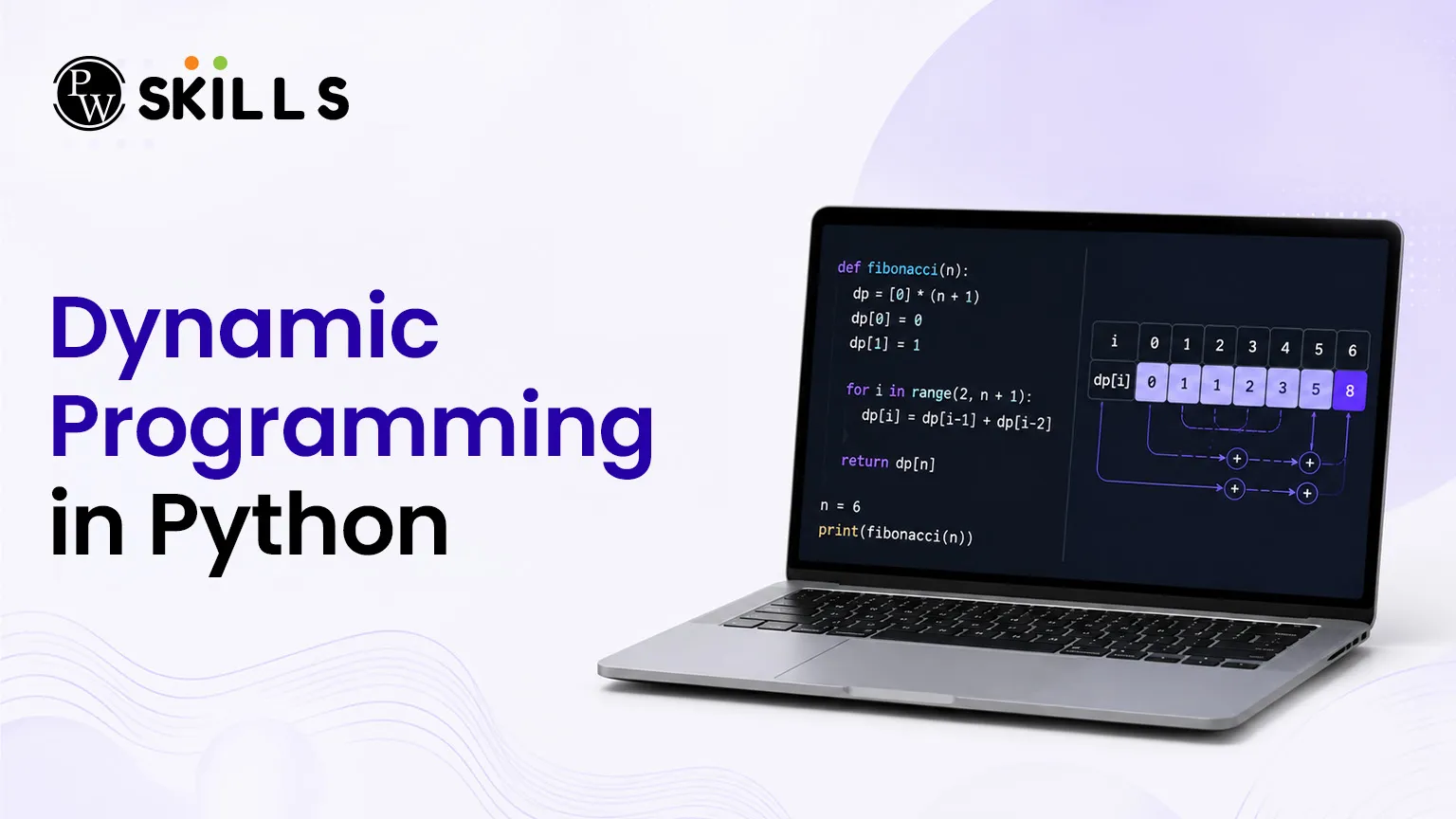
How to Solve the Fibonacci Problem with Dynamic Programming in Python?
The Fibonacci sequence serves as the standard baseline to understand how dynamic programming optimizes execution. The sequence starts with 0 and 1, and each subsequent number is the sum of the previous two numbers.
A standard recursive implementation has an exponential time complexity of $O(2^n)$, because it rebuilds huge duplicate execution trees. For example, calculating the 6th Fibonacci number causes the program to recalculate the 3rd Fibonacci value three times.
The table below highlights how dynamic programming completely alters performance metrics when scaling input values:
|
Optimization Level |
Programming Strategy |
Time Complexity |
Space Complexity |
|
Baseline Level |
Pure Recursive Approach |
$O(2^n)$ |
$O(n)$ |
|
Intermediate Level |
Top-Down Memoisation |
$O(n)$ |
$O(n)$ |
|
Advanced Level |
Bottom-Up Tabulation |
$O(n)$ |
$O(n)$ |
|
Maximum Level |
Optimized Space Tabulation |
$O(n)$ |
$O(1)$ |
Optimizing Tabulation Space
In the bottom-up approach, you might notice that calculating the current value only requires the results of the immediate past two indices. You do not need to keep the entire historical array in memory. By tracking just two active variables and updating them in a loop, you can achieve a highly optimized space complexity of $O(1)$.
How is Dynamic Programming in Python for Beginners?
Mastering dynamic programming requires recognizing patterns across different types of challenges. Below are walkthroughs of foundational patterns frequently encountered during technical assessments.
The House Robber Problem
Here's an example: a robber wants to steal money from a row of houses. The main constraint is that you cannot rob two adjacent houses on the same night because it will set off the automated security system. The goal is to steal as much as possible.
This scenario relies on a clear "take or not take" choice at each step:
-
Option A (Take): Rob the current house, add its wealth, and skip the immediate next house to move to index plus two.
-
Option B (Not Take): Skip the current house entirely and safely transition to the immediate next house.
An iterative array tracks the maximum wealth possible up to each house. For any house, the algorithm selects the maximum value between skipping it or robbing it along with the accumulated wealth from the two houses prior.
The 0/1 Knapsack Framework
The Knapsack problem is that you have a set of items , each with an associated weight and value , and you have a container that can hold up to a fixed weight . You must determine which combination of items to pack that will give you the maximum value without exceeding the weight limit.
The framework enforces a hard decision barrier: you either accept an item completely or reject it fully. No fractional parts. You build a 2D array where the rows are the items you can take and the columns are the increasing weight capacities. For each cell , the algorithm checks if the current item can fit in the remaining capacity . It picks the max of either including the item or excluding it .
Longest Common Subsequence (LCS)
The LCS problem focuses on finding the longest sequence of characters that appears in the same relative order across two separate strings. The characters do not need to occupy contiguous spaces in the original text.
This algorithm works by using a two-pointer comparison matrix:
-
If the characters at the current pointers match, the sequence length increases by one, and both pointers move forward.
-
If the characters do not match, the algorithm splits the path, advancing one pointer at a time to find the maximum possible length from both options.
Optimization Techniques for Dynamic Programming in Python
As problems grow more complex, you can apply specialized techniques to optimize performance and reduce runtime metrics.
Matrix and Grid DP
Many advanced algorithms operate on two-dimensional grids where you need to find a path from a top-left starting cell to a bottom-right destination cell. Usually, movement is restricted to downward or rightward directions.
To find the optimal path, the algorithm calculates values row by row. The cost to reach any specific cell depends on the values of its top and left neighbors. You can often optimize space by storing only the previous row's metrics instead of keeping the entire 2D matrix in memory.
Binary Search Integration
Certain sequence optimization challenges, such as finding the Longest Increasing Subsequence (LIS), can be optimized beyond standard DP limits. While a typical DP approach uses nested loops resulting in an O(n²) runtime, integrating binary search techniques can optimize this to O(n log n).
The algorithm maintains an active list of the smallest tail elements found for all increasing sequences. For each item in the input array, it uses binary search to quickly locate its position in the active list and update it, ensuring highly efficient processing.
DSA Interview Preparation for Dynamic Programming in Python
Succeeding in technical interviews requires a structured approach to problem-solving. Dynamic programming questions can seem intimidating, but you can master them by breaking them down systematically.
Use this step-by-step framework during your practice sessions:
-
Draft a brute-force recursive path first: Focus purely on the logical choices without worrying about performance.
-
Identify the changing variables: See which parameters modify across function calls to understand the dimensions of your lookup table.
-
Apply memoisation: Add a caching structure to your recursive code to eliminate duplicate processing.
-
Transition to tabulation: Convert your logic into an iterative loop structure to remove recursive overhead and save memory.



FAQs
What distinguishes dynamic programming from standard divide-and-conquer methods?
Why do some memoisation implementations cause runtime crashes for large inputs?
Can all dynamic programming table arrays be optimized for space?
How can you quickly determine if a problem can be solved with dynamic programming?
Is it better to use a list or a dictionary for top-down memoisation storage?





Get Free Counselling Today
and Clear up all your Doubts
 Live & recorded classes available at easeDashboard for progress trackingLakhs of practice questions

