
What is a Fibonacci Series in Python?
The Fibonacci Series In Python of a number is the sum of two preceding numbers. In this article, we will learn to write a Python program to print the Fibonacci series.
 Varun Saharawat30 Oct, 2025
Fibonacci Series in Python is a most sought-after intermediate-level programming question. It is often asked during many technical interviews. A Fibonacci number is a sequence of numbers in which every number in the sequence is added to the two previous numbers to find the current number. Let us read this article to write a program for printing the Fibonacci series in Python.
What is the Fibonacci Series in Python?
Fibonacci Numbers in Python is a sequence of numbers in which each number is the sum of two preceding numbers. In mathematical terms, the Fibonannci Series in Python F(n) is defined as F(0) = 0 F(1) = 1 F(n) = F(n-1) + F(n-2) for n>=2 So, the simplest Fibonacci series in Python is 0,1,1,2,3,5,8,13,21,34, and so on. Each subsequent number is calculated using the sum of the previous two numbers in the series. Let us know how to write the Fibonacci Series in Python.Mathematical Interpretation of the Fibonacci Series in Python
Fibonacci Series F(n) is a simple recurrence relation that can be represented using F(n) = F(n-1) + F(n-2) where n is the number. There are two base cases in this problem F(0) =0 and F(1) =1. Fibonacci series is a number series where each number is the addition of the previous two numbers in the series. In mathematical terms, it can be called a ‘recurrence relation’. A recursion relation is an equation that uses recursion to define a sequence of numbers that can be calculated using preceding terms.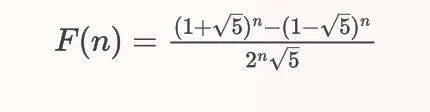 Using Binet’s Formula we can calculate the Fibonacci series in Python directly using mathematical expression using the golden ratio.
| Fibonacci Series in Python (Binet’s Formula) |
| import math def fibonacci(n): phi = (1 + math.sqrt(5)) / 2 psi = (1 - math.sqrt(5)) / 2 return int((phi**n - psi**n) / math.sqrt(5)) |
Fibonacci Series in Python Using a Loop
Let us write a program to print the Fibonacci series in Python using a loop. We can use a ‘while’ loop or ‘for’ loop for the purpose.| Fibonacci Series in Python using Loop |
| def fibonacci_series(n): a, b = 0, 1 for _ in range(n): print(a, end=" ") a, b = b, a + b Fibonacci_series(10) |
Output
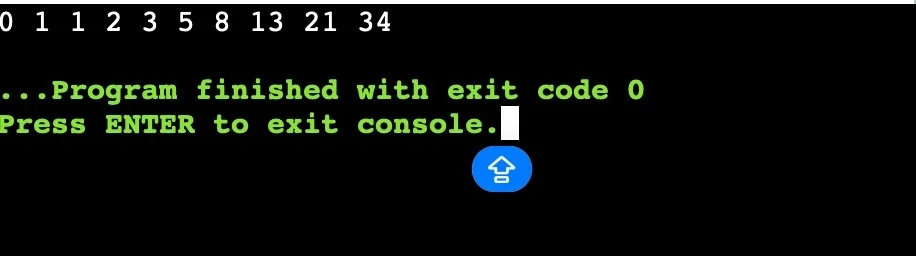 This function fibonnaci_series() takes two variables and assigns them with values 0 and 1. Now taking a for loop we keep on reassigning the value of a and b by assigning the value of b to a and assigning a+b to b. However, this function can only find the Fibonacci till a specified series.
Fibonacci Series in Python using Recursion
For recursion, we need a base case and repeated function call to print the Fibonacci series. Check the table below to print the Fibonacci Series using Python.| Fibonacci Series in Python using Recursion |
| def fibonacci_recursive(n): if n <= 1: return n else: return fibonacci_recursive(n-1) + fibonacci_recursive(n-2) def print_fibonacci_series(n): for i in range(n): print(fibonacci_recursive(i), end=" ") # Print Fibonacci series up to 10 numbers using recursion print_fibonacci_series(10) |
Output
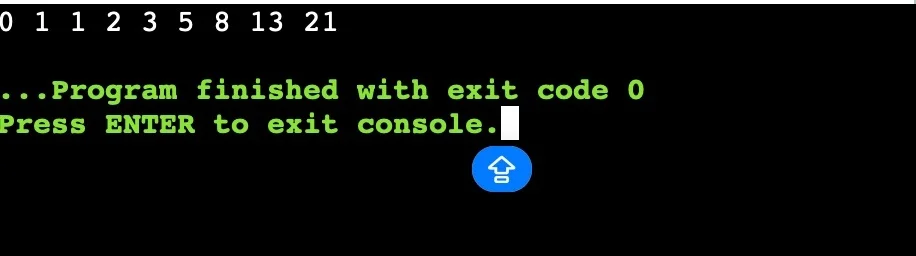 Here using the recursion function fibonacci_recursive() function we first take a base case when n is less than 1 and return the value of n. If n is greater than 1 then we call the sum of fibonacci_recursive(n-1) and fibonacci_recursive(n-2) repeatedly until the base case is reached.
Fibonacci Series in Python using Dynamic Programming
In Dynamic programming, we use the memoization approach to optimize the recursive method by storing the computed value in a variable to use later.| Fibonacci Series in Python using Dynamic Programming |
| memo = {0: 0, 1: 1} def fibonacci_memoization(n): if n in memo: return memo[n] memo[n] = fibonacci_memoization(n-1) + fibonacci_memoization(n-2) return memo[n] def print_fibonacci_series(n): for i in range(n): print(fibonacci_memoization(i), end=" ") # Print Fibonacci series up to 10 numbers using memoization print_fibonacci_series(5) |
Output
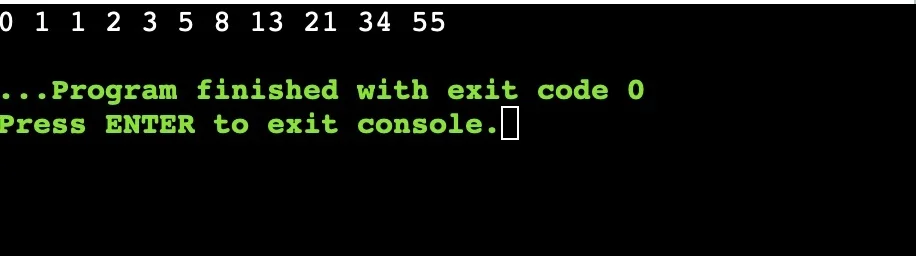 Here, using dynamic programming we store the value of 0 and 1 first in a variable memo. We created a function fibonacci_memoization() to find and print the Fibonacci series in Python using a dynamic programming approach. The time complexity of this approach is O(n) where n is the number.
Fibonacci Series in Python using Backtracking
We can use the backtracking approach of Python to print the Fibonacci series below.| Fibonacci Series in Python using Backtracking |
| def fibonacci(n, memo={}): if n <= 0: return 0 elif n == 1: return 1 elif n in memo: return memo[n] else: memo[n] = fibonacci(n-1) + fibonacci(n-2) return memo[n] print(fibonacci(7)) |
Learn Python Programming with PW Skills
If you are a beginner and want to learn Python Programming then enrol in our Decode Python with DSA Course to learn Python with interactive coursework and hands-on learning experience. Learn crucial concepts of Python with our experienced mentors. Get free interactive real-time industry projects, practice exercises, quizzes, doubt-free sessions, certification, and much more only at pwskills.com.



🔥 Trending Blogs
Fibonacci Series in Python FAQs
What is the Fibonacci Series?
Fibonacci Numbers in Python is a sequence of numbers in which each number is the sum of two preceding numbers.
How many methods are there to generate the Fibonacci sequence?
The Fibonacci series can be solved using loops, recursion or dynamic programming, and more.
What is the time complexity of the Fibonacci series using dynamic programming?
The time complexity using dynamic programming memoization is O(n).
Can I compute the Fibonacci Series in Python without using recursion?
Yes, we can use iteration to calculate the Fibonacci series using loops. We can also use famous formulas like Binet’s Formula.


Talk to a counsellorHave doubts? Our support team will be happy to assist you!



Get Free Counselling Today
and Clear up all your Doubts
Talk to Our Counsellor just by filling out the form.
Join 15 Million students on the app today!
 Live & recorded classes available at easeDashboard for progress trackingLakhs of practice questions

