
Kanban vs Scrum 101: Key Differences and Which Agile Fits You Best
 Varun Saharawat30 Oct, 2025
Kanban vs Scrum: Agile is that friend who says, "Don't plan your whole life at once, just always keep moving in the right direction." The two cousins in the Agile family get together most often; Kanban vs Scrum. Both sound good and promise speedy deliveries and confuses most mostly beginners.
So let's sit, pour some coffee, and unravel this Kanban vs Scrum mystery. You won't just know the difference by the end—you'll also know which of the two Kanban vs Scrum best suits your team, career, or even your inner working style.
What is Kanban?
Think of a whiteboard. Now picture it full of bright colored sticky notes that trot from 'To Do' into'Doing' and, finally, 'Done.' Congratulations-you have, just like that, visualized Kanban. [caption id="attachment_28469" align="alignnone" width="300"]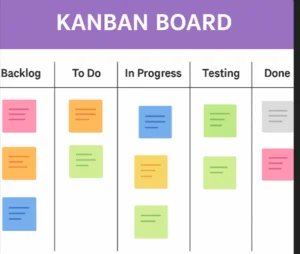 Kanban vs Scrum[/caption]
Kanban is a visual workflow management system which centers its attention on providing continuous delivery without a burden on the team. The word comes from Japan and means 'signboard.' First adopted by Toyota for activities related to manufacturing, software teams emulated the idea quite swiftly.
The philosophy is simple:
Kanban vs Scrum[/caption]
Kanban is a visual workflow management system which centers its attention on providing continuous delivery without a burden on the team. The word comes from Japan and means 'signboard.' First adopted by Toyota for activities related to manufacturing, software teams emulated the idea quite swiftly.
The philosophy is simple:
- Limit work in progress.
- Visualize everything.
- Improve the flow steadily.
What is Scrum?
Scrum, unlike Kanban, is to crush. Rugby is where you put huge people heads huddled, as in, it is from there that the name originated in Scrum (yes, rugby). In Agile, a metaphorical head lock is what a Scrum team performs-it's time in short bursts, called sprints (which usually lasts from 2-4 weeks), to tackle a problem.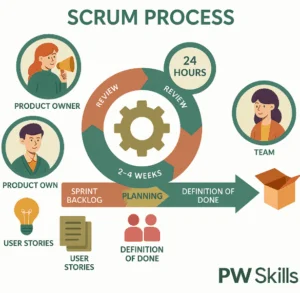 Scrum has roles (Product Owner, Scrum Master, Developers), ceremonies (daily standups, sprint planning, retrospectives), and artifacts (backlog, increments). It thrives on discipline, time management, and collaboration.
Like Agile but with a playbook. You don't wing things; you follow the rules, but you can bend them once you've mastered the game.
Scrum has roles (Product Owner, Scrum Master, Developers), ceremonies (daily standups, sprint planning, retrospectives), and artifacts (backlog, increments). It thrives on discipline, time management, and collaboration.
Like Agile but with a playbook. You don't wing things; you follow the rules, but you can bend them once you've mastered the game.
Kanban vs Agile: Are they same?
That's where most of them trips up. Agile is umbrella philosophy-"Deliver fast, adapt quickly, involve customer." All under that umbrella up there are Scrum and Kanban-different frameworks to achieving Agile.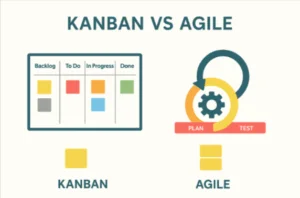 So Kanban vs Agile is not a fair fight. Kanban is part of Agile, not opposed to it. Like asking, "Is pizza better than Italian food?" Pizza is Italian food. In the same way, thus, Kanban is Agile.
Kanban vs Waterfall: Modern Feel Kanban
The Cascade model is the oldest grandparent software development. It has this linear mode: collecting requirements → design → code → test → deliver. You don't retreat once you've gone on to the next stage (it's like trying to climb a waterfall-good luck!).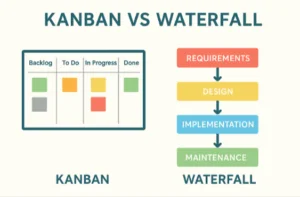 Yet, Kanban is the opposite; flexible, continuous changes, easy feedback, and faster delivery. This is exactly how Kanban vs Waterfall resembles Netflix (stream on demand) and scheduled TV Shows (miss it, and it's gone).
Difference Between Kanban vs Scrum With Example
Say you are developing a mobile app. In Scrum: The team plans a 2-week sprint. The tasks are locked. Even new feature requests that come midway are parked till the next sprint. You focus only on sprint goals. In Kanban: The tasks are always flowing. A new feature can be added to the board if it comes up (provided the work-in-progress limit isn't broken). No fixed sprint cycle: just progresses steadily.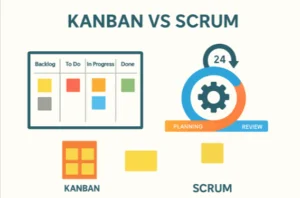 In brief:
Scrum = sprint race.
Kanban = marathon jog with water breaks.
In brief:
Scrum = sprint race.
Kanban = marathon jog with water breaks.
Kanban vs Scrum: Advantages and Disadvantages
| Aspect | Kanban Pros | Kanban Cons | Scrum Pros | Scrum Cons |
| Flexibility | Highly adaptable, new tasks can be added anytime. | Too much flexibility may cause lack of focus. | Provides clear structure with sprints. | Can feel rigid when priorities shift mid-sprint. |
| Implementation | Easy to adopt—just need a board (physical or digital). | Lack of formal roles may blur accountability. | Widely recognized with clear roles (PO, SM, Developers). | Needs training to implement correctly. |
| Workflow | Continuous flow, great for support or maintenance work. | Harder to predict delivery timelines. | Time-boxed sprints ensure regular delivery. | Sprint deadlines may create stress. |
| Visibility | Visual boards make progress easy to track. | Boards can get messy without discipline. | Artifacts (backlogs, increments) keep work transparent. | Over-documentation may creep in. |
| Team Dynamics | Less pressure on ceremonies and meetings. | Lack of rituals may weaken team alignment. | Strong collaboration rituals (daily standups, retrospectives). | Too many meetings can feel time-consuming. |
| Best Use Cases | Support teams, service desks, marketing pipelines. | Not ideal for long-term product roadmaps. | Product development, feature releases, startups. | Not great for interrupt-driven or highly reactive work. |
Why Change From Scrum to Kanban in Kanban vs Scrum?
When Scrum Feels Too Heavy for the Team
Scrum can provide structure to teams, but at times, some teams may begin to describe the ceremonies, fixed sprint cycles, and endless retrospectives as suffocating. Daily stand-ups may feel mechanical, and the sprint planning can eat away precious hours every two weeks. Kanban provides a lighter and more flexible methodology.For Interruption-Based Work Or Just Work That Is Hard-To-Predict
Support teams, DevOps, and IT maintenance teams often do not have predictable workloads. Urgent bugs, surprise tickets, or immediate client requests are inherently out of scope for the next sprint. Here, Kanban allows those unexpected tasks to flow in with ease without knocking the rhythm out of scheduling.Shifting Away from Fixed Goals to Continuous Flow
Scrum fixes scope for the sprint. Kanban welcomes changes to allow teams to add tasks on the fly-with consideration to work in progress (WIP) limits. It is liberating for companies that have changing priorities on a daily basis.Real-Life Scenarios: Kanban vs Scrum
Tech Support and Portions of the Service Prefer Kanban
Incoming tickets come in at random times; this is where Kanban's "pull when ready" approach works just right. Every issue becomes a card and flows across a board until resolved.Product Development Teams Run Best With Scrum
Scrum sprint planning focuses the team on building features, with clear deliverables every two weeks providing tangible output for constant forward momentum on a release cycle.Marketing and Creative Teams Incorporate the Two
Scrum for campaigning-the initiation has a fixed deadline, but ongoing activities like content writing or SEO audits are better done on a Kanban basis. The use of “Scrumban” has mixed discipline in many agencies.Non-IT Projects: Weddings, Construction, and Healthcare
Kanban is not purely IT-based. Event planners, hospital personnel, and construction crews utilize boards for task visualization. Scrum ceremonies, however, shine only in industries with a product focus that require rapid iteration cycles.Missteps That Break Agile: Kanban vs Scrum
Believing There Are No Rules Under Kanban
Kanban looks simple-just cards-on-a-board-but letting go of WIP limits in no time turns it into utter chaos. When work piles up, nothing is seen to be getting done and the board becomes nothing more than decoration.Under-Mini-Waterfalling the Scrum Methodology
Locking it down too tightly: Withholding mid-sprint changes belated feedback till the end and so defeating the very purpose Agile calls for fast adaptation are the mistakes that novices seem to make with Scrum.Confusing Project Manager with Scrum Master
The Scrum Master is a facilitator, coach, and blocker-remover, NOT one who "bosses people around" or assigns tasks. Such a confusion will only breed problems.Skipping Retrospective Or Continuous Improvement
Retrospectives are viewed as "gray" by teams. Failing to hold retrospectives leads to repeating the same mistakes, giving the framework a lifeless and routinized feel.How to Learn Kanban vs Scrum—Stepwise Roadmap
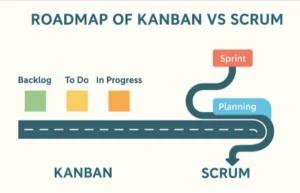 Step 1: Understand the Agile Manifesto
Before getting into tools, lay the foundation. Agile values customer collaboration, responding to change, and quickly delivering working solutions.
Step 2: Learning Scrum Roles, Ceremonies, and Artifacts
Learn the basics: Product Owner, Scrum Master, Developers. Study about sprint planning, daily standups, reviews, and retrospectives.
Step 3: Try Kanban Tools Like Trello or Jira
Step 1: Understand the Agile Manifesto
Before getting into tools, lay the foundation. Agile values customer collaboration, responding to change, and quickly delivering working solutions.
Step 2: Learning Scrum Roles, Ceremonies, and Artifacts
Learn the basics: Product Owner, Scrum Master, Developers. Study about sprint planning, daily standups, reviews, and retrospectives.
Step 3: Try Kanban Tools Like Trello or Jira
 Create a private board: To Do → Doing → Done. Practice moving tasks and applying limits to WIP.
 Step 4: Execute a Trial Sprint with Friends/Classmates
Find a small-ish project, break it into tasks, and complete a 2-week sprint. Have some real fun with standups and retros.
Step 5: Get Certified and Work on Projects
Scrum Master certification (CSM) or Kanban Management Professional (KMP) increases professional worth. Put theory onto practice in big projects in internships or jobs.
Step 6: Mix and Match (Learn Scrumban)
Few companies truly follow the textbook. Experiment with hybrids: sprint planning for big targets, Kanban boards for day-to-day flow.
Step 4: Execute a Trial Sprint with Friends/Classmates
Find a small-ish project, break it into tasks, and complete a 2-week sprint. Have some real fun with standups and retros.
Step 5: Get Certified and Work on Projects
Scrum Master certification (CSM) or Kanban Management Professional (KMP) increases professional worth. Put theory onto practice in big projects in internships or jobs.
Step 6: Mix and Match (Learn Scrumban)
Few companies truly follow the textbook. Experiment with hybrids: sprint planning for big targets, Kanban boards for day-to-day flow.
Templates for Kanban vs Scrum You Can Start With
Knowing theory is one thing; seeing it in practice is where magic happens. Most project- template tools offer light Kanban and Scrum templates so that you don’t have to do it from scratch. Term templates will guide you straight into action: following a college project, running a marketing project, or managing software sprints. Free Kanban Template on Jira: Try here Free Scrum Template on Jira: Try here Just pick one, explore, and you will feel immediately and sharply the difference between the sprint focus of Scrum and the continuous flow of Kanban. The sooner you get to testing, the quicker Agile clicks!Why You Must Consider Kanban vs Scrum
Agile is Everywhere in Modern Workplaces
From IT marketing to HR, the Agile framework's place is getting stolidly filled up. For this reason, you need to know the real wide difference between Kanban vs Scrum to remain flexible amongst different industries.Employers Expect Candidates to Be Agile-Fully-Literate
Securing increments of Agile experiences in demand within job descriptions. Even if you are not a Scrum Master or PM, with basic knowledge, your profile would be more valued.- The agile literacy is instrumental in money-making opportunities and salary elevation
- Roles like Scrum Masters, Agile Coaches, and Product Managers certainly open with agile fluency; getting paid extra, getting there fast.
Great Boost to Personal Productivity
Not just for teams, Kanban and Scrum are life savers: Students use Kanban boards to plan their studies, while freelancers can run Scrum sprints for their side projects. Mastering them keeps you sharp as an individual.Which Agile Fits You?
If You Like Structure and Rituals: Scrum Fits You You take pleasure in deadlines, sprint goals, teamwork rituals like standups: You shine in an environment where planning and reflection count just as much as execution. If You Value Flexibility and Visual Flow: Kanban Is Your Style You want to visualize your work, avoid overloading yourself with commitments, and adapt to changing priorities. Slowly but surely working forward seems to be a better proposition than being forced to meet sprint deadlines. If You Like Both Worlds: Go Hybrid With Scrumban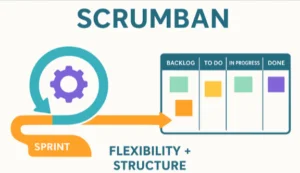 Numerous teams and individuals mix the two: sprints for big deliverables, Kanban boards for everyday flow. That is pure Agile: don't become a slave to the rules; bend them to suit your needs.
PW Skills: The Bridge to Your Kanban vs Scrum Future
Do you want to go from "I've heard of Agile" to "I lead Agile projects"? The PW Skills Product Management Course with AI gives you Scrum, Kanban, and beyond. Not just learning-actual career transformation- with industry projects, expert mentors, and placement. Take the plunge-outside help, and the world urgently needs more Agile leaders.


FAQs
Is Kanban easier than Scrum for beginners?
Can Kanban and Scrum be used together?
What industries most often use Scrum?
Do I need certification to get a Scrum- or Kanban-based job?





Get Free Counselling Today
and Clear up all your Doubts
 Live & recorded classes available at easeDashboard for progress trackingLakhs of practice questions

