

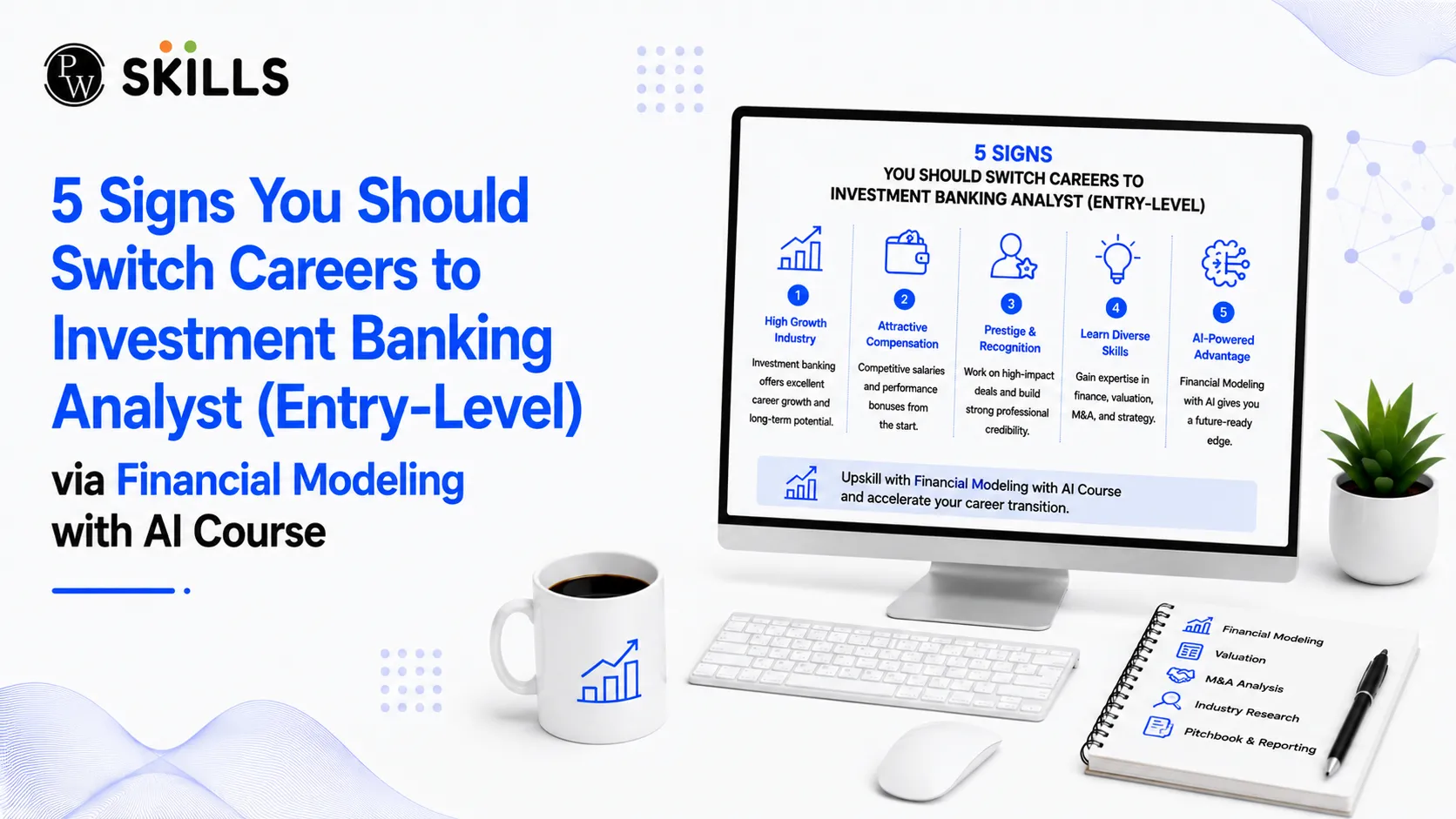
5 Signs You Should Switch Careers to Investment Banking Analyst (Entry-Level) via Financial Modeling
 Hardik Gupta20 Jul, 2026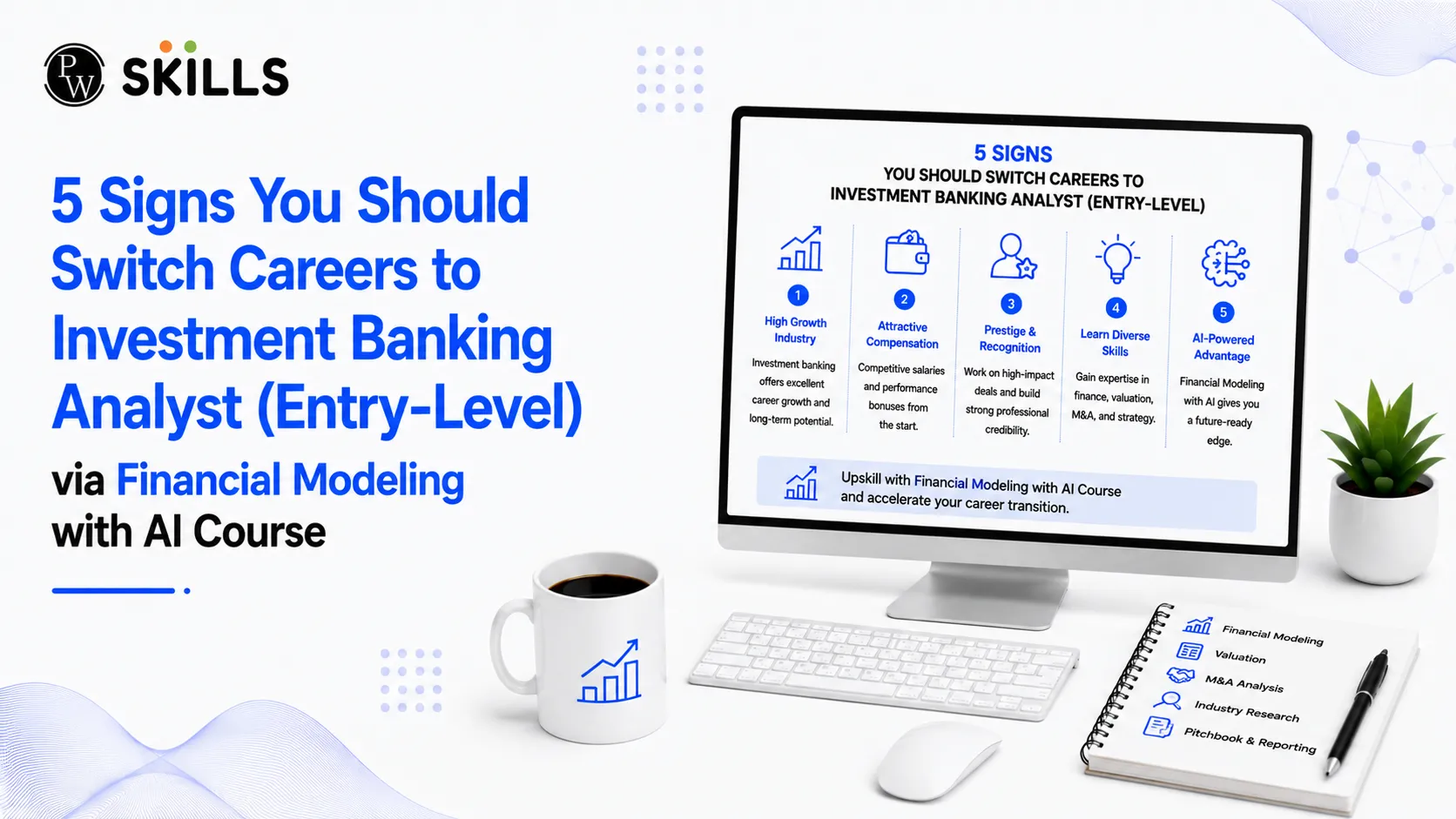
Financial Modeling with AI Course helps aspiring finance professionals build practical skills in valuation, forecasting, and financial analysis. As employers increasingly value job-ready expertise over traditional qualifications alone, this course prepares you to evaluate business opportunities, support financial decisions, and confidently pursue entry-level investment banking and corporate finance roles with industry-relevant technical knowledge.
Financial Modeling with AI Course Short Summary
This is a practical training program that combines traditional financial analysis with modern AI-powered tools. The course teaches important concepts such as financial statement analysis, forecasting, valuation techniques, discounted cash flow (DCF), scenario analysis, and financial planning. It also introduces AI-driven automation to improve data processing, reduce manual work, and increase model accuracy.
By combining finance knowledge with intelligent technologies, the course prepares learners for careers in corporate finance, investment banking, equity research, FP&A, and financial analyst roles. It helps professionals develop industry-ready skills that are increasingly important in today's technology-driven financial sector.
When to Choose a Financial Modeling with AI Course
If your daily routine has turned into an endless cycle of repetitive data entry, it is a clear indicator that your current career path may have hit a ceiling. True professional growth requires moving past mechanical tasks and stepping into a space where your analytical output directly shapes the financial future of major corporations.
Transitioning to high-paying finance roles requires more than just basic math skills; it demands proficiency in modern tools. Upgrading your skill set with a specialized training program helps you understand corporate valuation, forecasting, and automated data analysis, making you an ideal candidate for competitive entry-level positions.
You Are Stuck in Low-Growth Data Roles
Data entry and basic spreadsheet management often offer limited long-term upward mobility. If you want to transition into strategic decision-making, you need to learn how to build dynamic revenue projections, evaluate capital structures, and analyze historical company performance.
Moving beyond simple data tracking opens the door to prestigious career paths where your insights influence mergers, acquisitions, and corporate growth strategies.
Traditional Finance Degrees Feel Out of Reach
You do not need to spend years and thousands of pounds on a traditional business school degree to break into Wall Street or the City of London. Recruiters now value practical, demonstrable skills over expensive pieces of paper.
A modern, tech-focused certification allows you to build a professional portfolio of dynamic models that prove your capabilities to hiring managers instantly.
Signs You are Prepared for a Financial Analyst Career
If you are still unsure whether this career pivot makes sense for your specific professional situation, evaluate your current daily frustrations and long-term career goals against these five common behavioral patterns.
1. You Focus on Finding Efficiencies
If you are the type of professional who looks at a manual operational process and immediately tries to automate it using macros or basic scripts, you possess the exact mindset needed for modern corporate finance.
2. You Want Visible Impact on Big Decisions
Working in a isolated corporate department can make it difficult to see how your efforts contribute to the company's bottom line. Analysts see the direct results of their work in major public announcements and closed deals.
3. You Pick Up New Software Tools Quickly
The modern banking tech stack updates constantly. If you enjoy experimenting with new applications and data platforms, you will easily adapt to advanced financial analytics tools.
4. You Spot Patterns in Complex Numbers Easily
Valuation is more than just basic math; it involves understanding the underlying story that the numbers tell. If you naturally connect revenue spikes to macro economic trends, you have strong analytical instincts.
5. You Stay Calm Under Tight Deadlines
Deal environments move incredibly fast, requiring professionals to pivot strategies quickly without losing focus. If you thrive under pressure, the investment banking environment will suit your working style perfectly.
Financial Modeling AI Course for Investment Banking Careers
The entry-level analyst position serves as the ultimate training ground for anyone serious about a long-term career in high finance. It exposes you to complex corporate transactions, intense market analysis, and high-level networking opportunities that are impossible to find in standard corporate jobs.
Enrolling in a Financial Modeling with AI Course + Why choose this path highlights the immense leverage you gain by combining traditional accounting principles with predictive intelligence tools.
-
Accelerated Learning Curve: You will gain more technical knowledge in one year of banking than in three years at a standard corporate job.
-
Unmatched Networking: Work directly with senior managing directors, corporate executives, and venture capitalists on a regular basis.
-
High Compensation Potential: Entry-level finance roles offer some of the highest starting base salaries and performance bonuses in the global job market.
-
Exit Opportunities: Private equity firms, hedge funds, and corporate development teams actively recruit former investment banking analysts.
Financial Modeling Course and AI in Corporate Finance
The modern financial sector no longer relies entirely on manual data inputs and legacy calculations. Today, successful analysts use predictive algorithms and machine learning to process quarterly reports, track market sentiment, and build scalable forecasting frameworks in a fraction of the time it used to take.
Manual Data Entry ──> Python & AI Tools ──> Automated Forecasting & Valuation
By completing a comprehensive program, you position yourself at the intersection of traditional finance and cutting-edge technology. This unique combination makes you highly attractive for modern Financial Modeling with AI Course + Corporate Finance Analyst Jobs, where companies actively seek professionals who can leverage automation to reduce human error.
Valuation Process
Modern investment teams use automated tools to clean messy financial data, extract key numbers from filings, and populate core statement models automatically. This shifts your primary responsibility from simple data gathering to deep, high-level qualitative analysis.
Scenario Analysis
Instead of manually changing individual spreadsheet cells to test different business cases, intelligent prompts allow you to simulate thousands of market variables instantly, giving you a much clearer picture of potential investment risks.
Financial Modeling with AI Course for Equity Research Skills
A significant portion of an analyst's daily workload involves reading hundreds of pages of company filings, industry transcripts, and macroeconomic reports. Missing a single footnote can completely ruin a valuation model or compromise a live corporate deal.
Learning how to leverage technology for Financial Modeling with AI Course + AI-assisted equity research ensures you can synthesize massive amounts of data efficiently.
-
Rapid Document Parsing: Use specialized prompts to scan quarterly filings instantly for specific risk factors or management changes.
-
Automated Trend Synthesis: Extract historical growth rates across entire sectors to establish highly accurate baseline valuation multiples.
-
Real-Time Sentiment Tracking: Analyze earnings call transcripts automatically to gauge executive confidence and market reactions.
-
Competitor Benchmarking: Build dynamic peer-group comparison tables without spending hours copying data from individual investor relations pages.
Important Analyst Skills in a Financial Modeling Course
To successfully transition into a fast-paced investment environment, you must develop a core set of technical competencies that prove you can handle real-world deal execution from day one.
The following table breaks down the essential technical skills required for entry-level analyst roles and contrasts them with traditional, slower methodologies.
|
Core Finance Competency |
Legacy Manual Method |
Modern AI-Enhanced Method |
|
Three-Statement Modeling |
Hardcoding links between income statements and balance sheets manually. |
Using automated validation scripts to link statements and flags mismatches. |
|
Discounted Cash Flow (DCF) |
Calculating weighted average cost of capital via static desktop spreadsheets. |
Running dynamic simulations that adjust discount rates based on real-time market data. |
|
Trading Comparables |
Manually pulling enterprise value multiples for dozens of peer companies. |
Scraping financial databases automatically to update valuation metrics instantly. |
|
Pitch Book Creation |
Copying and pasting charts from spreadsheets into presentation decks. |
Using dynamic plug-ins to refresh visual charts as underlying models change. |
Financial Modeling with AI Course for Analyst Interviews
Breaking into investment banking without a traditional finance background requires a highly tactical approach to networking, resume building, and interview preparation.
Follow this sequence to position yourself effectively in front of top corporate recruiters.
1.Build the Core Technical Foundation:Weeks 1 to 6.
Dedicate focused time to learning accounting mechanics, corporate valuation theories, and automated spreadsheet design through a structured training curriculum.
2.Create a Verified Portfolio of Financial Models:Weeks 7 to 9.
Build and publish fully functional valuation models for real, publicly traded companies on GitHub or a personal portfolio website to serve as tangible proof of your technical abilities.
3. Optimise Your Professional Profile:Weeks 10 to 11.
Rewrite your CV and LinkedIn profile to highlight data competency, automated analysis skills, and your completed course credentials, using clear, impact-focused language.
4.Execute a Targeted Networking Campaign:Weeks 12 to 14.
Reach out directly to current entry-level analysts and associates at target firms to request short informational interviews, focusing on shared backgrounds or interests.
5.Learn the Technical and Behavioral Interview Process:Week 15 onwards.
Practice answering complex accounting questions, talking through your portfolio models smoothly, and explaining your explicit motivations for making the career pivot.





FAQs
How long does it take to learn financial modeling if I have zero background in accounting?
Can I get a job as an investment banking analyst if I am over the age of twenty-five?
Do I need to know how to write advanced computer code like Python to use AI in finance?
What is the average starting salary for an entry-level corporate finance analyst?
How does a course help me clear the technical rounds of a banking interview?







Get Free Counselling Today
and Clear up all your Doubts
 Live & recorded classes available at easeDashboard for progress trackingLakhs of practice questions

