

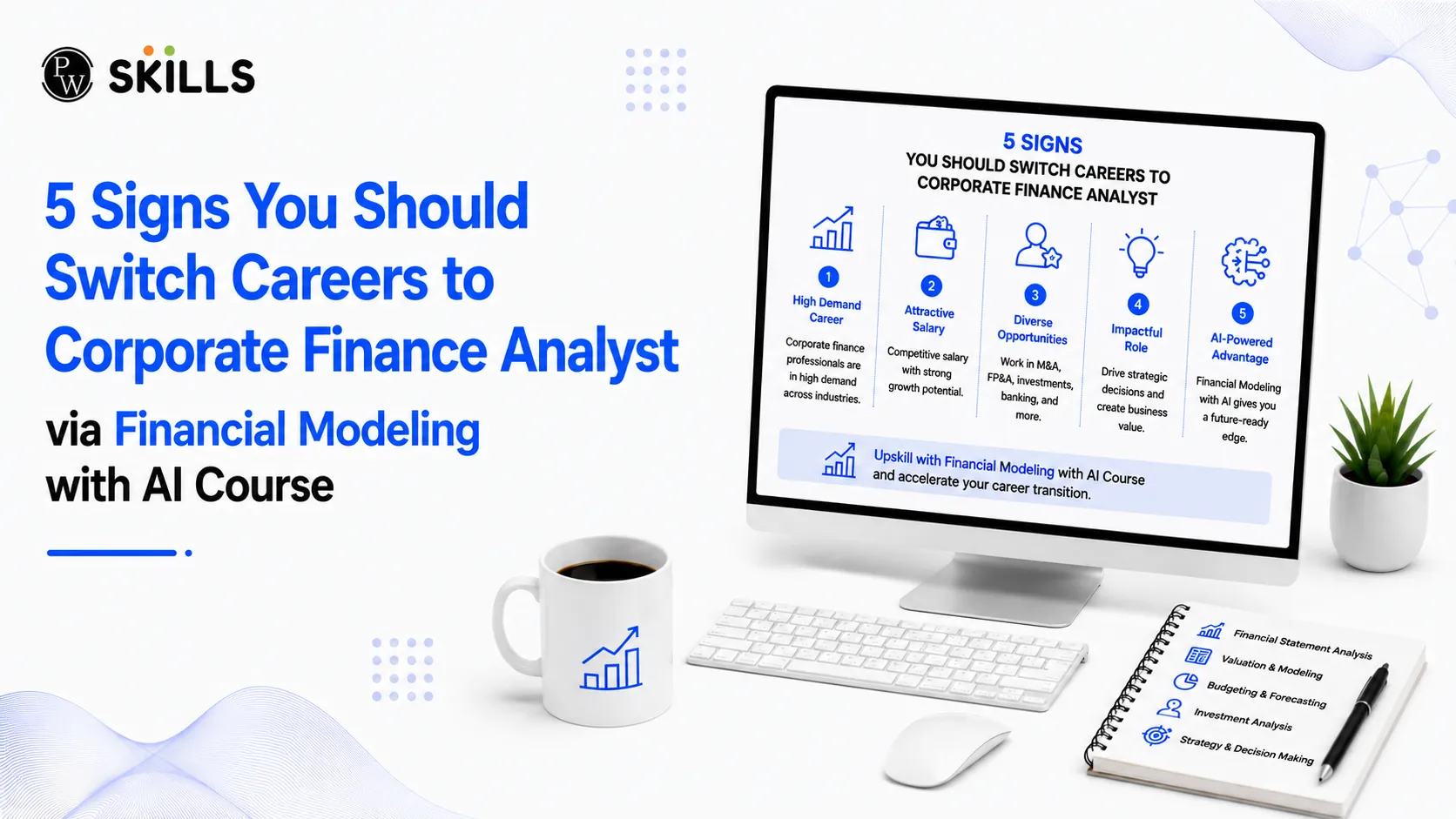
5 Signs You Should Switch Careers to Corporate Finance Analyst via Financial Modeling with AI Course
 Hardik Gupta20 Jul, 2026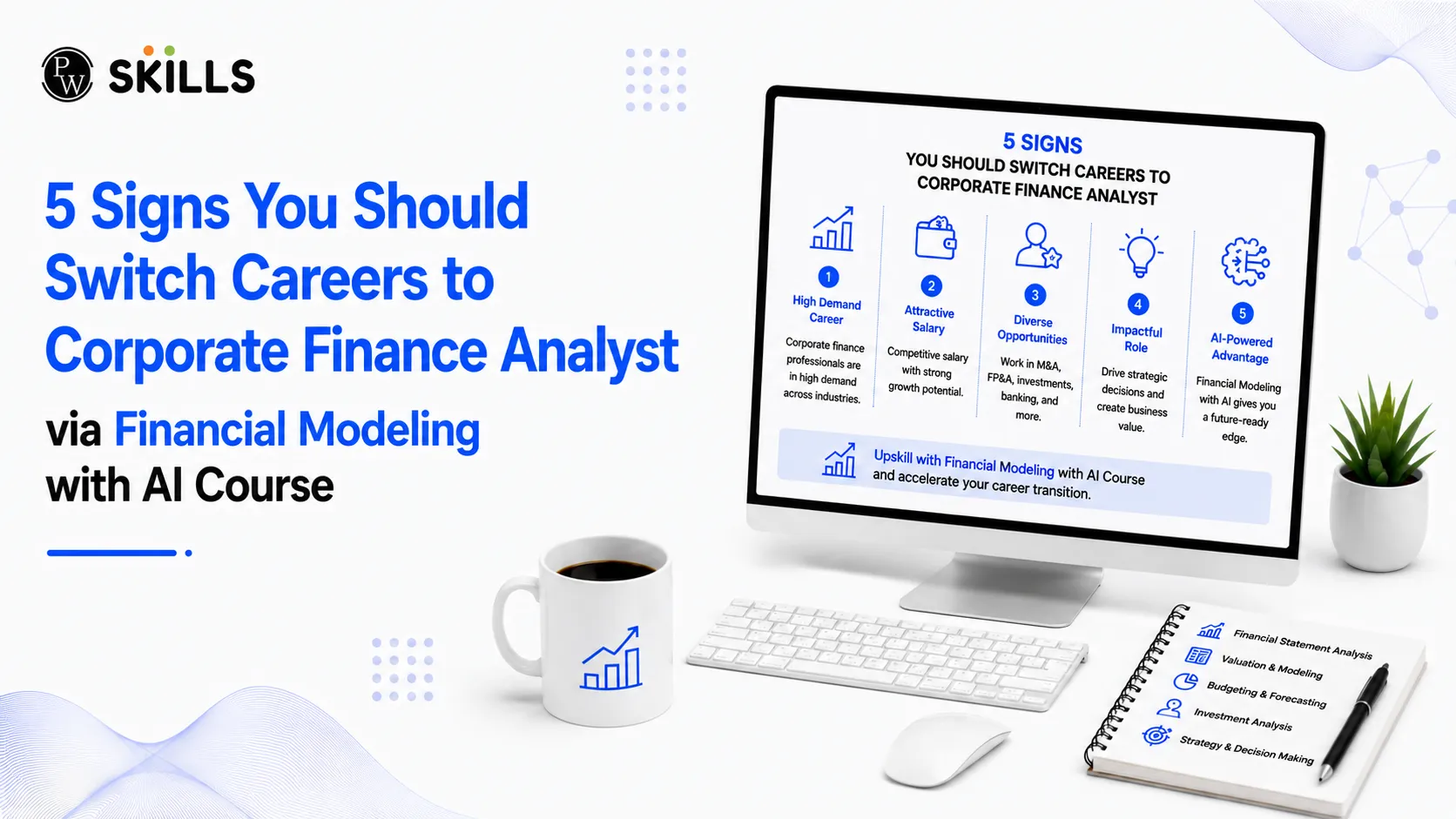
Companies increasingly rely on financial insights to drive business decisions, investments, and growth strategies. If your current role offers limited learning or career progression, it may be time to upskill. A Financial Modeling with AI Course equips you with practical skills in forecasting, valuation, and AI-powered financial analysis, helping you prepare for high-demand finance business analyst and corporate finance roles.
Importance of Financial Modeling with AI Course
AI financial modelling course is important because it combines core finance knowledge with modern automation tools used by today's companies. It helps professionals improve forecasting, valuation, and financial analysis while reducing manual work and errors. The course also prepares learners for high-demand roles in corporate finance, investment analysis, and financial planning, making their skills more relevant and future-ready in a technology-driven industry.
A clear absence of vertical progress is a key indicator that you need to change careers. Due to changing economic conditions, there are less prospects for progression in many traditional sectors. Your skill set may become outdated if manual data input or out-of-date reporting are part of your regular routine.
Modern corporate finance teams now demand professionals who can blend traditional finance with automation. Professionals look at a Financial Modeling with AI Course + Why it bridges this gap, offering a structured path out of career stagnation. Acquiring these tech-driven skills helps you transition from routine administrative work to high-level strategic planning.
5 Signs a Financial Modeling with AI Course Is Right for You
If you relate to these signs, it may be the right time to build your skills with this AI Course and transition into a corporate finance analyst role.
Sign 1: You Enjoy Solving Business Problems
Corporate finance is a great career choice if you have a natural aptitude for trend analysis, data-driven decision-making, and business performance analysis. Financial insights are used by analysts to help strategic planning and corporate expansion.
Sign 2: You Want to Be Part of Business Decisions
Corporate finance analyst positions offer more strategic participation if you want your job to impact budgeting, investments, and expansion plans instead of just routine reporting.
Sign 3: You Enjoy Working with Data and Excel
Financial modelling may probably appeal to you if you enjoy making spreadsheets, assessing data, and producing reports. You may turn these abilities into useful business insights with the aid of this training.
Sign 4: You Want Better Career Growth
Gaining expertise in financial modelling and artificial intelligence (AI) might lead to better-paying finance and business analyst positions if your current position offers few learning chances or poor pay development.
Sign 5: You Want Future-Ready Finance Skills
Modern finance teams increasingly use automation and AI for forecasting and analysis. Learning these tools through this course prepares you for the evolving demands of corporate finance.
Key Skills to Build for a Corporate Finance Analyst Career
To make a successful career transition, focus on developing these skills:
-
Advanced Data Interpretation: Turn financial data into meaningful business insights.
-
Predictive Forecasting: Build financial models to estimate future revenue, costs, and growth.
-
Scenario Analysis: Evaluate different business outcomes to support decision-making.
-
Strategic Communication: Present financial insights clearly to stakeholders and leadership teams.
Financial Modeling Course for AI and Automation
Traditional financial planning relied heavily on manual data consolidation, which was slow and prone to human error. Today, artificial intelligence automates the collection and cleaning of massive datasets, allowing analysts to focus entirely on strategy. This shift means modern analysts spend less time fixing broken spreadsheet formulas and more time analyzing growth opportunities.
Learning these automated workflows is essential to remaining competitive in the current job market. A comprehensive AI financial modelling course introduces you to machine learning algorithms that detect anomalies and predict cash flows. Understanding this technology ensures you can deliver rapid, high-precision insights that traditional analysts cannot match.
Financial Modeling with AI Course and Corporate Finance Jobs
Upskilling opens doors to several specialized pathways within corporate finance departments. Companies want professionals who can evaluate corporate health, structure mergers, and optimize capital allocation using modern software.
The market shows a strong link between a Financial Modeling with AI Course + Valuation Analyst Jobs, as automated valuation is now standard practice. The table below outlines the core career paths available after learning these tools.
|
Corporate Finance Role |
Primary Responsibility |
Key Skill Utilized |
|
Corporate Finance Analyst |
Evaluates internal capital projects and operational budgets |
Financial statement forecasting |
|
Valuation Analyst |
Determines the economic worth of assets or entire companies |
Discounted cash flow automation |
|
FP&A Specialist |
Drives long-term budgeting and strategic variance analysis |
Predictive trend modeling |
|
Treasury Analyst |
Manages liquidity, cash holdings, and financial risk mitigation |
Real-time cash flow monitoring |
Financial Modeling with AI Course for Technical Finance Skills
To excel in corporate finance, you must understand the art of structuring corporate financial data cleanly. This involves linking historical financial statements together so that any change in operational assumptions updates the entire model.
Through a Financial Modeling with AI Course + Financial statement modeling modules, you learn to connect the income statement, balance sheet, and cash flow statement automatically. The course teaches you to integrate smart prompts and automated scripts to stress-test your assumptions. This foundational technical skill ensures your corporate models remain accurate, dynamic, and completely error-free.
Quick Tip: When building your first integrated model, always ensure your balance sheet plugs check out to zero automatically before applying any automated predictive filters.
How to Transition with a Financial Modeling AI Course
Making a successful career pivot requires a structured approach to learning and networking. You cannot rely on theoretical knowledge alone; you must build a verifiable portfolio of practical work.
Follow this sequence to transition smoothly into a corporate finance analyst position:
-
Learn Core Accounting Principles: Understand the mechanics of double-entry bookkeeping and corporate financial structures.
-
Learn Automated Model Construction: Build dynamic projection models using advanced software and intelligent data scripts.
-
Create a Practical Portfolio: Design and share complex case studies showcasing your ability to value real-world companies.
-
Target Modern Job Openings: Focus your search on forward-thinking firms that actively seek tech-savvy financial analysts.
Career Mistakes to Avoid After a Financial Modeling AI Course
One major mistake professionals make is ignoring the impact of automation on modern financial reporting. Relying solely on legacy spreadsheet methods will make it difficult to compete against candidates who know how to use smart algorithms.
Another error is failing to showcase practical problem-solving skills to recruiters. Simply listing certifications on a resume is rarely enough. You must actively demonstrate that you can use advanced tools to solve actual corporate finance problems during your interviews.





FAQs
What is the primary benefit of enrolling in an AI-powered financial modeling course?
How does financial statement modeling help in corporate finance decision making?
Can professionals from non-finance backgrounds transition into valuation analyst jobs?
Why is traditional financial modeling shifting toward automated technology?
What specific tools are learned in a modern financial modeling training program?






Get Free Counselling Today
and Clear up all your Doubts
 Live & recorded classes available at easeDashboard for progress trackingLakhs of practice questions

