

You Should Switch Careers to NLP Engineer via Data Science with Generative AI Course
 Hardik Gupta20 Jul, 2026
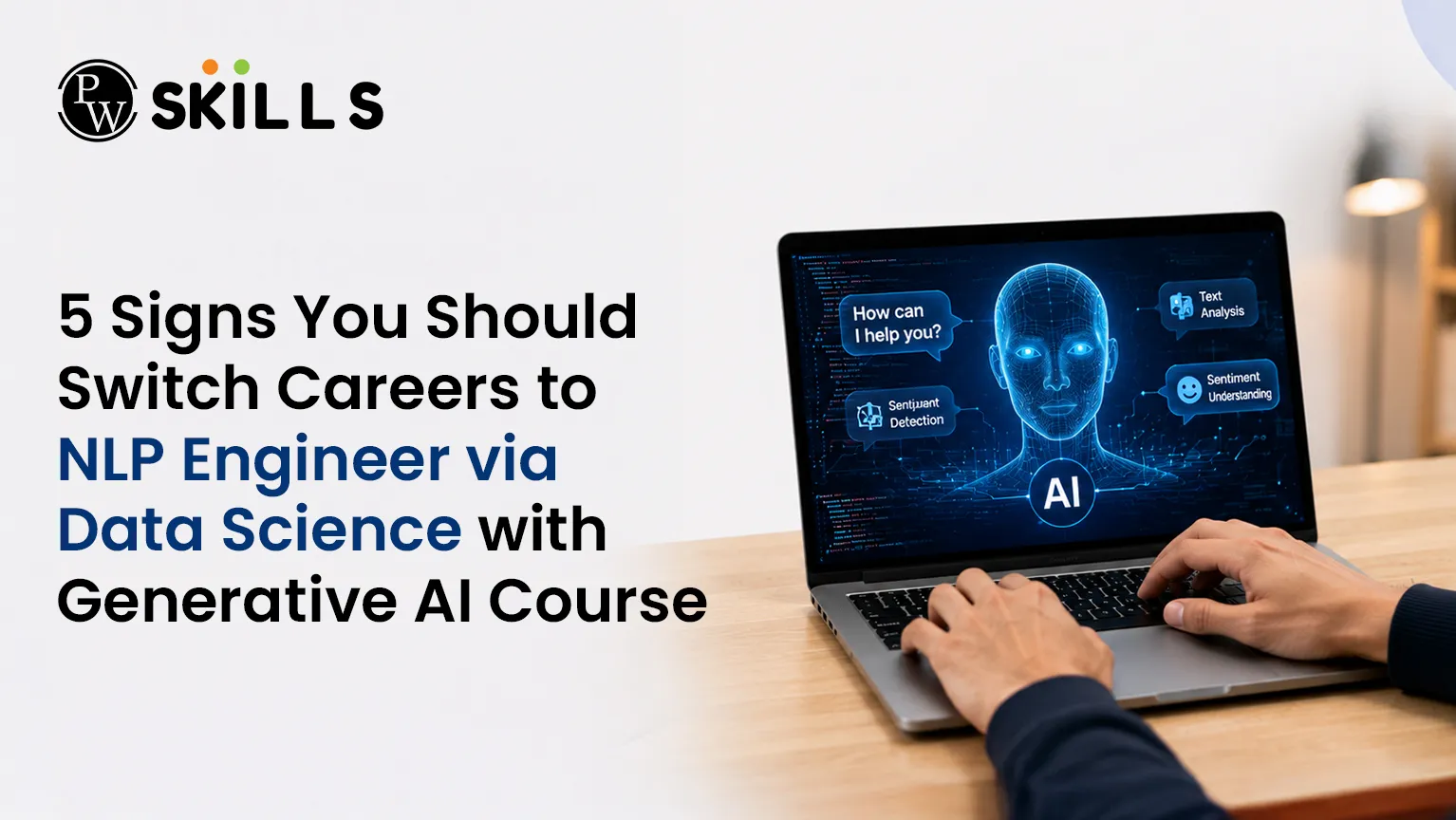
Entering a comprehensive Data Science with Generative AI Course offers a practical solution to modernise your skills and transition into high-demand engineering roles. Moving towards Natural Language Processing (NLP) allows you to work directly with large language models, conversational systems, and complex text computing.
Why Choose a Data Science with Generative AI Course?
Navigating a career change requires more than just self-study; it demands a structured learning path that connects standard machine learning principles with advanced neural engineering. Enrolling in a targeted Data Science with GenAI Course provides the exact framework needed to make this shift successfully.
|
Phase |
Key Focus Areas |
|
Phase 1: Foundations |
Python, SQL, Applied Statistics |
|
Phase 2: Core Machine Learning |
Regression, Decision Trees, Data Pipelines |
|
Phase 3: Deep Learning |
Transformers, BERT, LLM Fine-Tuning |
|
Phase 4: Production & Deployment |
RAG (Retrieval-Augmented Generation), MLOps, API Deployments |
A dedicated program balances foundational analytics with modern deployment techniques. You will learn to use specialized Python libraries, manage deep learning frameworks like PyTorch, and clean large, unstructured text datasets. This balanced curriculum ensures you master the exact production methodologies that modern technology teams expect.
How to Know If You Need a Data Science with Generative AI Course?
Recognising the right time to pivot your career can prevent professional stagnation and unlock higher earning potential. The shift from general engineering or classic data analytics to specialized language systems often hinges on specific technical indicators.
1. You Feel Restricted by Tabular Data Pipelines
Working exclusively with rows, columns, and clean relational databases can eventually limit your professional growth. If you find yourself wanting to solve complex, unstructured problems like contextual text analysis, semantic search, or automated document translation, it is a clear sign to pivot. Moving beyond basic structured databases allows you to manage real-world, complex text data.
2. Basic Predictive Automation Stalls Your Daily Motivation
Building standard linear regressions or simple forecasting scripts might feel repetitive if you want to create highly interactive systems. Transitioning to specialized language engineering enables you to deploy intelligent agents that understand human intent, recognise emotional nuances, and generate context-aware code or text.
3. Industry Demands for Specialized Language Skills are Rising
Modern technology teams are shifting budgets toward intelligent text processing, context-aware customer systems, and advanced enterprise search frameworks. If you notice that your current technical profile lacks exposure to modern neural architectures, it is time to upgrade. A structured educational program helps close this gap efficiently.
Benefits of Data Science with Generative AI Course Career
Specializing in language processing involves understanding how modern enterprise systems interact with human text. By mastering these current frameworks, you place yourself ahead of traditional developers who rely solely on static coding methods.
Building Scalable RAG Architectures
Retrieval-Augmented Generation (RAG) is a critical component of modern enterprise applications. It connects a core language model to external business files, ensuring responses are accurate, factual, and fully updated.
Fine-Tuning Lightweight Open-Source Models
Many modern enterprises prefer adjusting small, open-source models rather than paying for massive, external cloud systems. Mastering hyperparameter tuning and custom alignment allows you to adapt specialized open-source models for highly specific business tasks.
Implementing Agentic Multi-Step Workflows
The industry is moving quickly away from simple prompt-and-response interfaces toward independent AI agents. Learning to build these autonomous systems means you can design workflows that plan steps, execute code, and call APIs to solve complex operational challenges.
How Does a Data Science with Generative AI Course Prepare You for Applied Data Scientist Jobs?
The job market has evolved into two distinct operational pathways for data professionals. Understanding where these pathways lead helps you choose the right training and position your profile accurately for open roles.
|
Operational Track |
Primary Work Focus |
Core Technical Stack |
|
Research Track |
Theoretical discovery, publishing algorithmic papers, developing new mathematical architectures from scratch. |
Academic frameworks, deep mathematical theory, advanced statistical research modules. |
|
Applied Track |
Packaging models into production, fine-tuning tools, building scalable enterprise APIs. |
Python, PyTorch, MLOps platforms, vector databases, cloud deployment tools. |
Focusing your studies on a Data Science with Generative AI Course + Applied Data Scientist Jobs pathway ensures you gain practical, production-ready skills. Instead of focusing purely on abstract theory, you will build live systems that resolve actual business bottlenecks. This production focus makes you highly attractive to global engineering hubs and technology teams.
What Skills Will You Learn in a Data Science with Generative AI Course?
Before deploying large-scale neural networks, you must build a strong foundation in core analytical principles. A successful transition relies heavily on combining basic programming logic with advanced computational methods.
|
Learning Area |
Key Skills Covered |
|
Core Mathematics |
Applied Statistics, Probability, Vector Calculus |
|
Programming & ML Tools |
Python, Pandas, Scikit-learn, PyTorch |
|
Production Frameworks |
Vector Databases, LLM APIs, MLOps, RAG Pipelines |
Applied Mathematics and Data Processing
A reliable Data Science with Generative AI Course + Statistics component gives you the mathematical tools needed to evaluate complex language patterns. You will study probability distributions, vector similarities, and error metrics to debug production models effectively.
Deep Learning and Vector Spaces
Modern language models represent text as high-dimensional numbers inside a vector space. You will master embedding models, semantic database indexing, and transformer architectures to build fast, accurate text-retrieval applications.
How Does a Data Science with Generative AI Course Prepare You for NLP Engineer Careers?
Review these definitive indicators to see if your current professional trajectory matches the requirements of a modern language engineering role.
-
You regularly use Python to clean data, but want to use it to build deep learning pipelines and manage transformer networks.
-
You notice your organization struggles to process customer emails, internal documents, or support chats using regular keyword filters.
-
You want to move away from building simple internal dashboards and start deploying client-facing language applications.
-
You are fascinated by how modern systems translate languages, track sentiments, and summarize long texts accurately.
-
You want to transition your career into a high-growth field that protects your professional value against automation.




FAQs
What does an NLP engineer do on a typical workday?
Is deep mathematical knowledge required to begin learning language engineering?
How does language engineering differ from traditional data analytics?
Can I switch to this specialization if my current background is in non-tech fields?
Why are businesses prioritising open-source models over external cloud APIs?





Get Free Counselling Today
and Clear up all your Doubts
 Live & recorded classes available at easeDashboard for progress trackingLakhs of practice questions

