

5 Signs You Should Switch Careers to Data Scientist via Data Science with Generative AI Course
 Hardik Gupta20 Jul, 2026
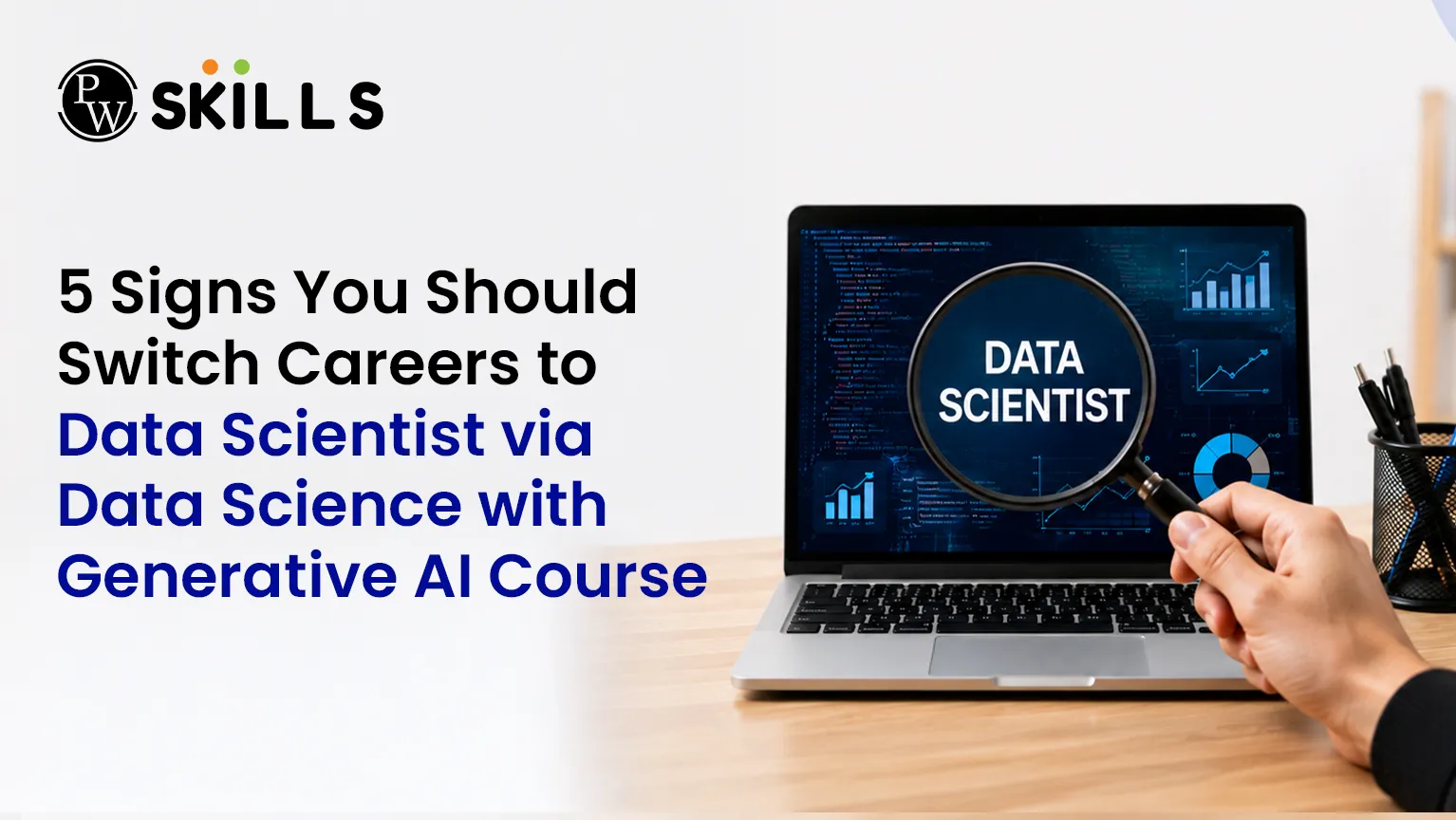
The demand for data scientists continues to grow as businesses rely more on AI-powered insights to solve complex problems and make faster decisions. However, many professionals remain in roles that offer limited exposure to advanced analytics, predictive modeling, or intelligent automation, making long-term career growth challenging.
If you're looking to transition into a role with stronger learning opportunities and higher earning potential, a Data Science with Generative AI Course can help you make that shift. Through hands-on projects, industry-relevant tools, and practical experience in machine learning, generative AI, and data science, the course prepares you to confidently pursue a successful career as a data scientist.
What is the Data Science with Generative AI Course?
The world of data is changing faster than ever before. Companies no longer want professionals who only create reports and study old data. They want experts who can build smart systems that predict future trends, automate tasks, and generate useful business insights in real time.
A Generative AI Course in Data Science prepares you for this new generation of technology careers. The program combines data science, machine learning, and Generative AI skills to help you address modern business problems with intelligent solutions. From predictive analytics and automation to language models and AI applications, the course gives you the practical knowledge needed to succeed in today's fast-growing data industry.
5 Signs to Switch Careers with Data Science with Generative AI Course
The demand for NLP professionals is growing fast as companies use AI to understand and work with human language. If these signs match your career goals, it may be the right time to move into this high-growth field.
Sign 1: Your Current Technical Role Lacks Career Growth
Many technical professionals reach a point where their daily tasks become entirely mechanical. Data entry, basic software maintenance, or traditional IT support rarely offer long-term financial or intellectual satisfaction. When your learning curve flattens, your market value drops.
Transitioning to advanced analytics solves this stagnation. The global demand for experts who understand both data structures and intelligent automation is at an all-time high. By choosing a dedicated Generative AI Course in Data Science, you learn how to build intelligent systems rather than just managing old software. This specific education bridges the gap between traditional coding and modern business intelligence.
Sign 2: You Want to Enter the Field of Advanced Automation
Traditional data analytics focuses heavily on past events by generating charts from historical spreadsheets. However, modern industries now require predictive and creative data solutions. If you find yourself wanting to build systems that generate text, code, or predictive models, a standard analytics track is no longer enough.
Modern automation relies on foundation models and large-scale data architecture. Enrolling in a comprehensive training program shows you how to leverage these tools effectively. The table below highlights how the professional landscape changes when you choose a Data Science with Generative AI Course + why it outpaces traditional learning routes.
|
Traditional Data Analytics |
Advanced Data Science with Generative AI |
|
Focuses on historical spreadsheets and static dashboards |
Builds predictive models and automated content generators |
|
Uses basic SQL and descriptive statistical tools |
Deploys deep learning and large language infrastructure |
|
Limited to manual data cleaning and interpretation |
Automates data synthesis and complex pattern recognition |
Sign 3: You Are Interested in Specialized NLP Engineer Jobs
Natural Language Processing has moved from academic research directly into core commercial products. If you enjoy working with text data, translation tools, or conversational systems, entering this domain offers exceptional long-term stability.
A modern curriculum prepares you directly for these specialized roles. When you complete a targeted Data Science with Generative AI Course + NLP Engineer Jobs become highly accessible because you master the exact mechanisms that power modern semantic understanding. Organizations look for professionals who can tune large models for custom text analysis.
Key skills you will master for these modern linguistic roles include:
-
Vector Embeddings: Transforming text into mathematical matrices for precise machine comprehension.
-
Semantic Search: Building search engines that understand user intent rather than just matching exact keywords.
-
Text Summarization: Designing automated pipelines that condense massive corporate legal or financial documents cleanly.
Sign 4: You Want to Solve Complex Problems Using Advanced NLP
Analytical professionals often feel constrained by simple numerical forecasting. If you want to build systems that analyze consumer sentiment, translate languages instantly, or write code, you need a specialized technical foundation.
Focusing on language models unlocks these capabilities. Embracing a Data Science with Generative AI Course + NLP focus gives you the tools to build systems that process human language at scale. This combination allows you to transition from a general analyst to a highly specialized engineering professional.
Sign 5: You Seek a Future-Proof Profession with High Financial Rewards
The tech landscape changes quickly, and skills focused on manual operations face systemic obsolescence. To protect your career, you must align your skillset with corporate automation budgets.
Data experts who understand generative architecture command excellent compensation because they directly lower operational costs for businesses. Investing your time in a structured training program ensures your skills remain relevant for the next decade.
Important Factors to Remember Before Choosing a Data Science with Generative AI Course
Choosing the right Data Science with Generative AI Course can significantly influence your learning experience and future career opportunities. Before enrolling, evaluate the curriculum, hands-on projects, industry relevance, mentorship, and placement support to ensure the course aligns with your career goals.
Focus on Practical Projects
Choose a program that includes real projects and hands-on learning instead of only theory.
Learn Industry Tools
Make sure the course covers popular tools and technologies that companies currently use.
Build a Strong Portfolio
Your projects and portfolio are often as important as your certificate during job applications.
Practice Regularly
Learning data science and AI requires continuous practice and problem-solving.
Understand the Basics First
A strong foundation in programming, statistics, and data handling makes advanced topics easier to learn.
Stay Updated with New Technologies
The AI industry changes quickly, so continuous learning is important for long-term success.
Improve Communication Skills
Being able to explain technical results in simple business language is an important skill for career growth.
How to Start Your Journey with a Data Science with Generative AI Course?
Building a successful career in data science requires a strong foundation and consistent hands-on practice. Following the right learning approach during a Data Science with Generative AI Course helps you develop the technical skills needed for real-world AI and data science roles.
Start with the Mathematical Fundamentals
Before training complex systems, you must understand the basic calculations that drive them. Focus your initial energy on linear algebra, probability, and basic statistical distributions to ensure your models perform predictably in production environments.
Practice with Real Industrial Datasets
Theoretical knowledge will not suffice during intense technical interviews. Build clean portfolios by cleaning messy, real-world data and deploying your predictive models on public cloud hosting environments.



FAQs
Is data science a good career choice in 2026?
Can beginners switch to a data science career?
Do I need advanced mathematics to become a data scientist?
How important are projects when applying for jobs?
What industries hire data science professionals?





Get Free Counselling Today
and Clear up all your Doubts
 Live & recorded classes available at easeDashboard for progress trackingLakhs of practice questions

