

Machine Learning vs Deep Learning: What You'll Learn in a Data Science with Generative AI Course
 Hardik Gupta7 Aug, 2026
Artificial Intelligence (AI) powers many modern technologies. It enables machines to mimic human intelligence. AI branches into several specialized areas. Among these, Machine Learning (ML) and Deep Learning (DL) are fundamental. They are crucial for extracting insights from data. Understanding their distinctions is vital for aspiring professionals. This blog will explore Machine Learning vs Deep Learning: What You'll Learn in a Data Science with Generative AI Course. This helps in choosing the right educational path.
What is Machine Learning?
Machine Learning involves teaching computers to learn from data. It does this without explicit programming instructions. Algorithms identify patterns and make predictions. ML models improve performance with more data. Common types include supervised, unsupervised, and reinforcement learning. Applications range from email spam detection to medical diagnoses. Machine Learning forms the bedrock of many data-driven solutions today.
What is Deep Learning?
Deep Learning is a subset of Machine Learning. It uses artificial neural networks with many layers. These networks process complex patterns in data. DL excels with unstructured data like images, audio, and text. It automatically discovers features from raw inputs. Examples include facial recognition and natural language processing. Deep Learning drives advanced AI systems. It allows for highly accurate, complex problem-solving.
Machine Learning vs Deep Learning: Key Differences
The primary distinction lies in how they handle feature extraction. ML often requires manual feature engineering. DL automatically learns features through its multi-layered networks. Deep Learning generally needs more data and computational resources. This is due to its complex architecture. ML models are typically easier to interpret. DL models can be more like "black boxes."
|
Feature |
Machine Learning (ML) |
Deep Learning (DL)
|
|---|---|---|
|
Data Requirement |
Effective with less data |
Requires vast datasets |
|
Feature Engineering |
Manual, domain expert input often needed |
Automatic, learned by network |
|
Computational Power |
Moderate |
High, often needs GPUs |
|
Interpretability |
Generally good, transparent models |
Often low, complex internal workings |
|
Problem Complexity |
Suited for structured data, simpler tasks |
Excels with complex, unstructured data |
What You'll Learn in a Data Science with Generative AI Course
This section details the curriculum. You will gain a deep understanding of core AI concepts. The course covers fundamental Machine Learning algorithms. It also explores advanced Deep Learning architectures. Expect to learn data preprocessing, model training, and evaluation techniques. A significant part focuses on Generative AI application building. This includes diffusion models and large language models. You learn to create innovative AI solutions. The course emphasizes practical projects and real-world tools. You will master both theoretical concepts and hands-on implementation.
Developing Practical AI Skills Through Structured Learning
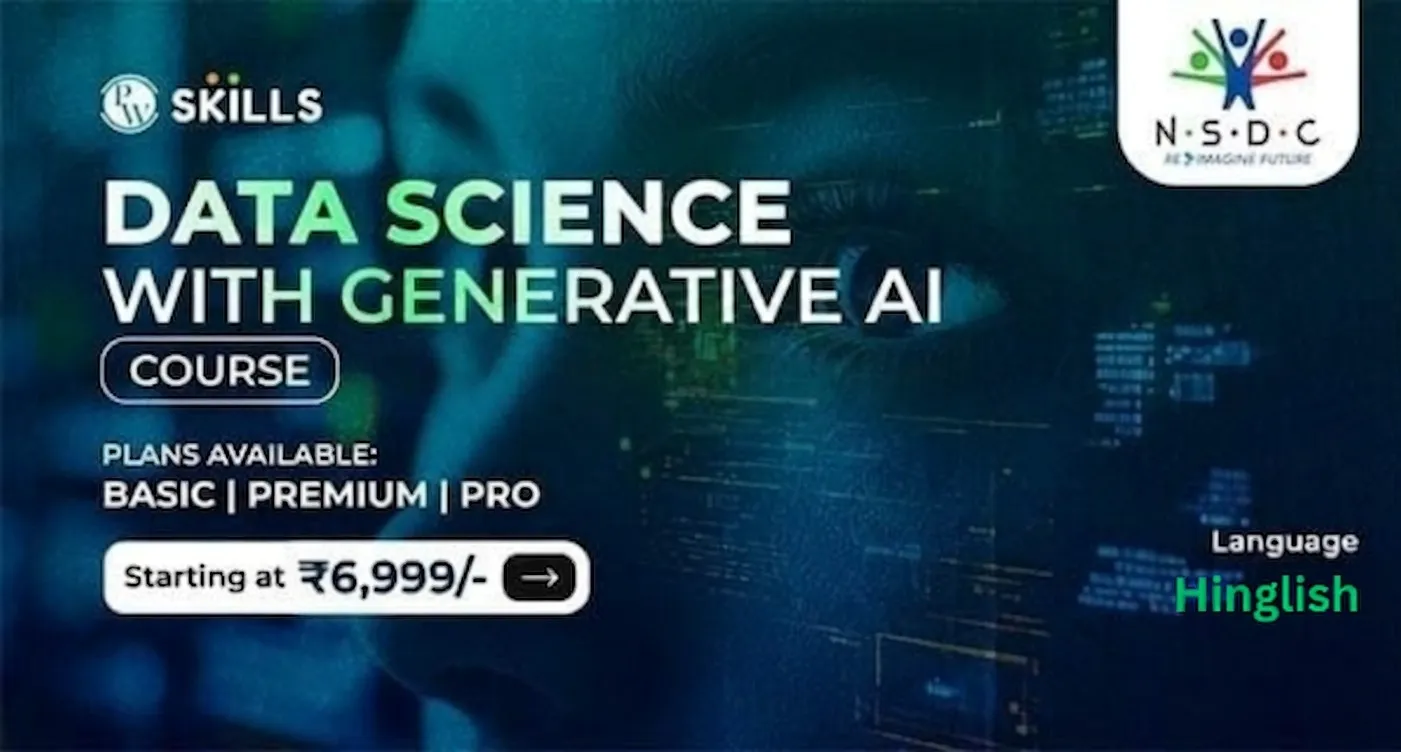
Building expertise in Machine Learning, Deep Learning, and Generative AI requires a balance of theoretical knowledge and practical implementation. The PW Skills Data Science with Generative AI Course follows an eight-month industry-oriented curriculum that covers Python, SQL, Excel, Statistics, Exploratory Data Analysis (EDA), Machine Learning, Deep Learning, NLP, MLOps, and Generative AI. Alongside core concepts, learners work on hands-on assignments, capstone projects, industry case studies, and project portfolio development, enabling them to apply algorithms and AI models to real-world business problems. The program also includes weekend live sessions, mentorship from experienced industry professionals, career guidance, interview preparation, and a PW Skills + NSDC certification, helping learners build industry-relevant skills. Designed for beginners, fresh graduates, and working professionals, the curriculum focuses on developing practical expertise in modern AI technologies while strengthening the analytical and programming skills required for roles such as Machine Learning Engineer, Deep Learning Engineer, AI Engineer, and Data Scientist.
Career Prospects: Machine Learning Engineer Jobs
A strong foundation in data science and AI is highly valued. Graduates who understand Machine Learning vs Deep Learning: What You'll Learn in a Data Science with Generative AI Course can pursue diverse roles. Popular options include Machine Learning Engineer Jobs. These professionals develop and deploy AI models. Other roles are Data Scientist, AI Researcher, or Deep Learning Engineer. The demand for these specialized skills continues to grow. Expertise in Generative AI offers a competitive edge. This helps secure leading positions in technology companies.
Conclusion
Understanding the nuances of Machine Learning vs Deep Learning: What You'll Learn in a Data Science with Generative AI Course is vital. Both fields offer powerful tools for data analysis. This specialized training equips you with skills for impactful careers. You learn to build advanced AI systems. This includes practical Generative AI application building.




FAQs
1. What is the main difference between Machine Learning and Deep Learning?
2. Will a Data Science with Generative AI course teach both Machine Learning and Deep Learning?
3. Which is better for beginners: Machine Learning or Deep Learning?
4. What career opportunities are available after learning Machine Learning and Deep Learning?
5. Why is Generative AI included in a Data Science course?





Get Free Counselling Today
and Clear up all your Doubts
 Live & recorded classes available at easeDashboard for progress trackingLakhs of practice questions

