

K Nearest Neighbor Algorithm (KNN) Explained – Effective 2025 Guide
 Varun Saharawat30 Oct, 2025
In the world of machine learning, one of the first algorithms you would be going through is k nearest neighbor. The algorithm in itself is simple, intuitive, and surprisingly effective. While neural networks turn out to be more complex, machine learning algorithms like k nearest neighbor act almost like humans: they glance around for nearby points and make a decision.
In this edition of 2025, we will delve into the KNN- What is it, how does it work, why is it still relevant in today's AI world, and how can you use it with real-life examples, formulas, and Python code?

K Nearest Neighbor Algorithm
K nearest neighbor is a supervised learning algorithm that is said to be a lazy algorithm. Why? Because it does not learn during the training phase but instead waits for observation of the new data point to then decide about the point by comparing it with existing one. Suppose you have recently moved into a city; if those around you want to determine what you might fancy, be it a coffee shop, a gym, or a movie genre, they check what your closest neighbor likes. This is what the k nearest neighbor algorithm does in machine learning.
How K Nearest Neighbor Works
To answer how does k nearest neighbor work, let’s break it down step by step:- Choose K – Decide how many neighbors to consider (k).
- Calculate Distance – Find how close existing data points are to the new one.
- Select Neighbors – Pick the k closest data points.
- Vote or Average – For classification, take a majority vote; for regression, take the average.
Mathematical Foundations of K Nearest Neighbor
The distance calculation is the backbone of the k nearest neighbor algorithm. The most widely applied formulas are: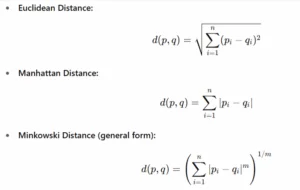 The choice of the right metric can build or break the accuracy in k nearest neighbor.
Choosing the Right Value of K in K Nearest Neighbor
The foremost crucial decision in k nearest neighbor algorithm is selecting k:- Small k (like k=1 or 3): Very sensitive; may misclassify due to noise.
- Large k (like k=15 or 20): Smoother, but may ignore finer details.
K Nearest Neighbor Example in Real Life
Triple K Nearest Neighbors in Simple Terms:- Health care: Predict if a tumor is malignant or benign by checking for patient data similar to that of the new patient.
- E-Commerce: Recommending products to a shopper by comparing them with buyers who have purchased similar items.
- Social Media: Suggesting friends on Facebook or LinkedIn by looking at mutual connections.
Python Implementation of K Nearest Neighbor
 Students often wonder how to implement the k nearest neighbor algorithm in machine learning. Here is a short Python snippet:
from sklearn.datasets import load_iris
from sklearn.model_selection import train_test_split
from sklearn.neighbors import KNeighborsClassifier
from sklearn.metrics import accuracy_score
# Load dataset
iris = load_iris()
X, y = iris.data, iris.target
# Train-test split
X_train, X_test, y_train, y_test = train_test_split(X, y, test_size=0.3, random_state=42)
# Initialize KNN
knn = KNeighborsClassifier(n_neighbors=5)
# Train the model
knn.fit(X_train, y_train)
# Predict
y_pred = knn.predict(X_test)
# Accuracy
print("Accuracy:", accuracy_score(y_test, y_pred))
This is one of the most common k nearest neighbor examples taught to beginners.
Students often wonder how to implement the k nearest neighbor algorithm in machine learning. Here is a short Python snippet:
from sklearn.datasets import load_iris
from sklearn.model_selection import train_test_split
from sklearn.neighbors import KNeighborsClassifier
from sklearn.metrics import accuracy_score
# Load dataset
iris = load_iris()
X, y = iris.data, iris.target
# Train-test split
X_train, X_test, y_train, y_test = train_test_split(X, y, test_size=0.3, random_state=42)
# Initialize KNN
knn = KNeighborsClassifier(n_neighbors=5)
# Train the model
knn.fit(X_train, y_train)
# Predict
y_pred = knn.predict(X_test)
# Accuracy
print("Accuracy:", accuracy_score(y_test, y_pred))
This is one of the most common k nearest neighbor examples taught to beginners.
 Join Our Data Science Telegram Channel
 Join Our Data Science WhatsApp Channel
Why do students and professionals still love the k nearest neighbor algorithm?
- Easy to implement and interpret.
- Works for both classification and regression.
- Makes no assumptions regarding data distribution.

Demerits of K Nearest Algorithm
K nearest neighbor algorithm in machine learning does have some shortcomings, even though it maybe my simpletons:- In huge datasets, scanning needs to be done for each prediction (slow).
- Sensitive to irrelevant features.
- Struggles with high-dimensional categorization.
Applications of K Nearest
The KNN algorithm powers a lot of applications in the real world:- Banking: Fraud Detection.
- Medicine: Predicting Diseases.
- Retail: Customer Segmentation.
- Computer Vision: Face Recognition Systems.

Comparison of K Nearest to Other Algorithms
A quick comparison:| Algorithm | Training Time | Prediction Time | Flexibility | Use Case |
| KNN | Fast | Slow | High | Baseline models, small data |
| Decision Trees | Medium | Fast | Medium | Classification tasks |
| SVM | Slow | Medium | High | Complex boundaries |
| Logistic Regression | Fast | Fast | Low | Binary classification |
K Nearest Neighbor Algorithm in 2025 and Beyond: The Future
Even in this commercial deep learning age, the algorithm in machine learning is still very much in play:- Distance computations with optimal libraries grow faster.
- Hybrid approaches combining KNN with other models for increased accuracy.
- Because of its simplicity, it is being widely used at the edge computing and IoT devices.
Also Read:
- What is K Means Clustering? An Effective Guide with Examples (2025)
- What is Gradient Descent? A Beginner's Guide to the Learning Algorithm
- Master Hypothesis Testing – From Basics to Real-World Scenarios
- What is Data Ingestion? A 12 Step Beginner-Friendly Guide to Mastering the Basics
Learn Data Science with PW Skills
If you want to not just read but actually implement algorithms, PW Skills offers a Data Science Course designed for students and working professionals. After the hands-on projects, mentorship, and real-life use cases, you will have no limits on K and will be confident to perform in your career using machine learning.



🔥 Trending Blogs
K Nearest Neighbor FAQs
Is the k nearest neighbor algorithm used in deep learning?
No, but before deep learning methods are applied, it is often used as a baseline model.
Is k nearest neighbor applicable when dealing with text data?
Yes, when the text is converted into numerical vectors through TF-IDF or word embeddings.
Why is k nearest neighbor considered a lazy learner?
Because it doesn't build a model while training; it only retains data.
Does k nearest neighbor work for high dimensional data?
Not always, since it has to fight its way through the curse of dimensionality. Some form of feature reduction is often done.


Talk to a counsellorHave doubts? Our support team will be happy to assist you!



Get Free Counselling Today
and Clear up all your Doubts
Talk to Our Counsellor just by filling out the form.
Join 15 Million students on the app today!
 Live & recorded classes available at easeDashboard for progress trackingLakhs of practice questions

