

Free GitHub Courses to Learn Data Science and Artificial Intelligence
 Hardik Gupta26 Sept, 2026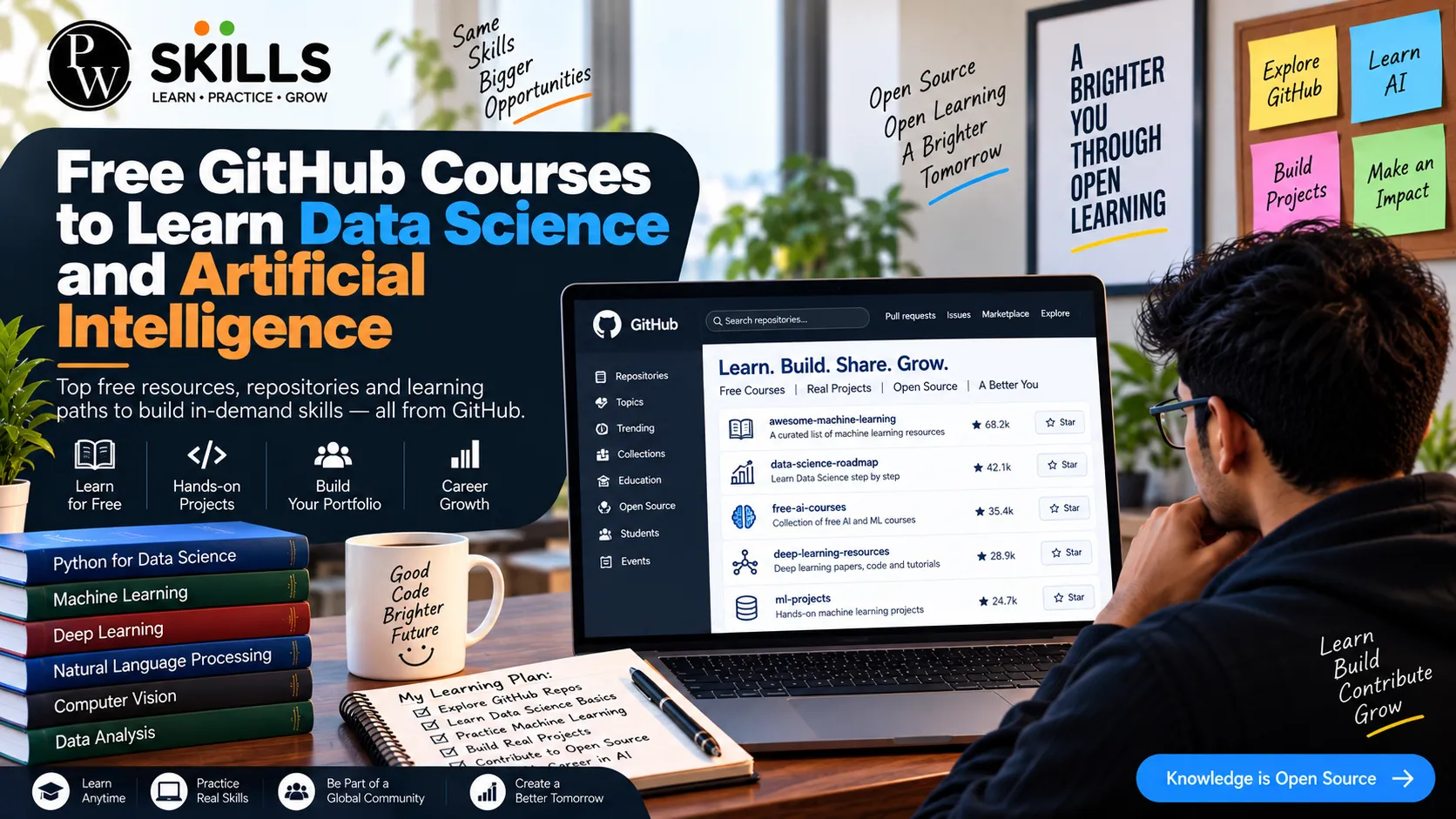
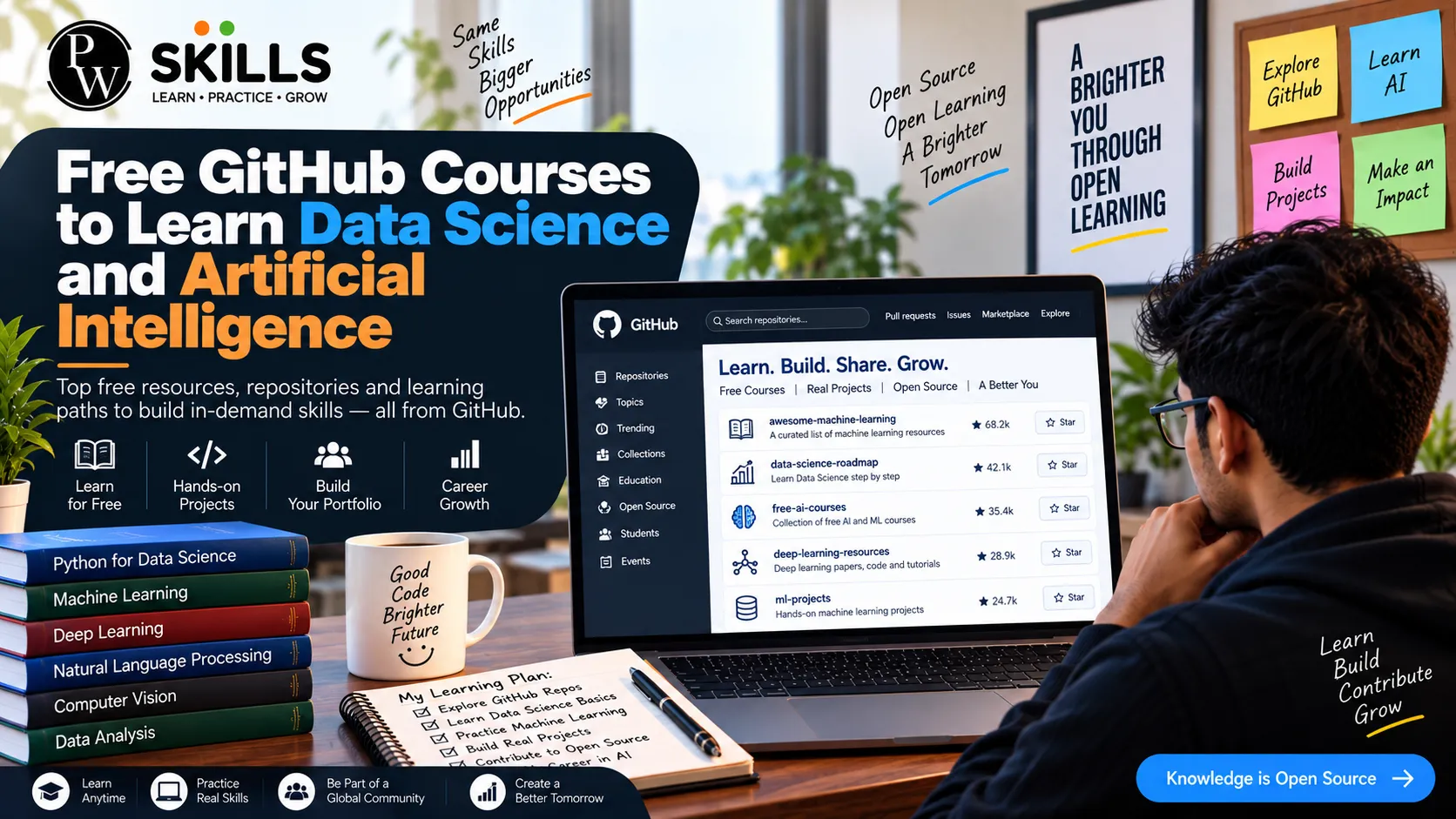
The good news is that beginners do not always need to invest in an expensive programme to start learning. There are several free courses, GitHub repositories, tutorials, documentation resources, and hands-on projects available online that can help learners understand the fundamentals of Python, statistics, data analysis, machine learning, and artificial intelligence.
GitHub is particularly useful for learners because it provides access to open-source projects, course materials, coding exercises, datasets, notebooks, and practical examples. However, with thousands of repositories available, finding the right learning resources can sometimes be challenging.
This article explores useful GitHub courses and learning resources for different types of learners and explains how a structured programme such as the PW Skills Data Science with Generative AI Course can complement self-learning.
1. GitHub Courses
GitHub is more than a platform for storing and sharing code. It has become an important learning resource for students, developers, data science enthusiasts, and technology professionals.
Learners can find repositories containing:
-
Data science tutorials
-
Python programming exercises
-
Machine learning projects
-
Artificial intelligence resources
-
Jupyter notebooks
-
SQL practice exercises
-
Data analysis projects
-
Generative AI projects
-
Open-source datasets
-
Course notes and learning roadmaps
Many GitHub repositories are organised like complete courses, with modules, exercises, assignments, and projects. This makes GitHub courses useful for learners who prefer practical and self-paced learning.
However, learners should evaluate repositories carefully and check whether the content is updated, complete, and aligned with their learning goals.
2. GitHub Courses For Beginners
For beginners, GitHub can provide a practical way to supplement basic programming and data science learning.
Someone starting from scratch can look for repositories covering:
-
Python fundamentals
-
Programming concepts
-
NumPy and Pandas
-
Basic statistics
-
SQL
-
Data visualisation
-
Introduction to machine learning
-
Jupyter Notebook tutorials
A beginner-friendly approach is to choose one learning path rather than downloading multiple repositories and trying to complete everything simultaneously.
For example, a learner can start with Python, practise basic programming problems, and then progress to data manipulation using Pandas before moving into machine learning.
This approach can help create a stronger foundation before tackling advanced artificial intelligence concepts.
3. GitHub Courses For Students
Students pursuing computer science, engineering, mathematics, statistics, or related fields can use GitHub to supplement their academic learning.
GitHub courses for students can provide additional practical exposure to concepts that may be introduced through classroom lectures.
Students can use GitHub repositories to practise:
-
Python programming
-
Data structures and algorithms
-
SQL
-
Statistics
-
Data analysis
-
Machine learning
-
Deep learning
-
Artificial intelligence
-
Generative AI
GitHub can also help students understand how real-world projects are organised. By studying open-source repositories, students can observe coding practices, documentation, project structures, and implementation approaches.
Students can further strengthen their portfolios by creating their own repositories and documenting projects they build during their learning journey.
4. GitHub Courses For Working Professionals
Working professionals looking to transition into data science or expand their existing technical skills can also use GitHub as a learning resource.
GitHub courses for working professionals can be particularly useful for self-paced learning because professionals can study repositories, notebooks, and projects according to their available schedule.
Professionals can focus on areas that complement their existing experience, such as:
-
Python for data analysis
-
Business analytics
-
Machine learning
-
Data visualisation
-
Generative AI
-
Large Language Models
-
AI-powered applications
For professionals, project-based learning can be particularly valuable because it provides an opportunity to apply concepts to practical business problems.
For example, someone working in finance could build a financial data analysis project, while a marketing professional could explore customer segmentation or campaign performance datasets.
5. GitHub Courses for CS Students
Computer science students can use GitHub to go beyond theoretical concepts and gain hands-on experience with modern technology stacks.
GitHub courses for CS students can cover a broad range of topics, including programming, databases, machine learning, artificial intelligence, and software development.
CS students interested in data science can create a learning path around:
-
Python programming
-
SQL and databases
-
Data structures and algorithms
-
Statistics and probability
-
Data analysis
-
Machine learning
-
Deep learning
-
Generative AI
-
Data science projects
Working through GitHub projects can also help CS students become familiar with version control and collaborative development workflows.
6. Start with Python for Data Science
Python is one of the most widely used programming languages in data science and artificial intelligence. Beginners should ideally start by understanding Python fundamentals before moving into machine learning or advanced AI concepts.
Some of the important Python concepts to learn include:
-
Variables and data types
-
Conditional statements and loops
-
Functions
-
Lists, tuples, dictionaries, and sets
-
Object-oriented programming basics
-
File handling
-
Exception handling
-
Working with libraries and packages
Once the fundamentals are clear, learners can move towards data science-focused libraries such as NumPy, Pandas, Matplotlib, and Seaborn.
7. Learn Data Analysis and Visualisation
Data science is not only about building machine learning models. A large part of the workflow involves collecting, cleaning, analysing, and visualising data.
Beginners can start by learning:
-
Data preprocessing
-
Exploratory Data Analysis (EDA)
-
Handling missing values
-
Data manipulation
-
Statistical analysis
-
Correlation and distribution analysis
-
Dashboard and reporting fundamentals
Python libraries such as Pandas, NumPy, Matplotlib, and Seaborn are commonly used for these tasks.
A learner can take a publicly available dataset, clean it using Pandas, identify trends, and create visualisations to communicate the findings.
8. Understand Statistics for Data Science
Statistics is another important foundation for data science and machine learning.
Before moving into advanced machine learning concepts, beginners should understand topics such as:
-
Mean, median, and mode
-
Variance and standard deviation
-
Probability
-
Distributions
-
Sampling
-
Correlation
-
Regression
-
Hypothesis testing
-
Confidence intervals
A strong statistical foundation can help learners understand how data is interpreted and how machine learning models make predictions.
9. Explore Machine Learning
After learning Python, data analysis, and statistics, the next step is to understand machine learning.
Machine learning enables computers to identify patterns in data and make predictions or decisions based on those patterns.
Beginners can start with:
Supervised Learning
Supervised learning uses labelled data to train models. Common algorithms include:
-
Linear Regression
-
Logistic Regression
-
Decision Trees
-
Random Forest
-
Support Vector Machines
-
K-Nearest Neighbours
Unsupervised Learning
Unsupervised learning works with data where predefined labels are not available.
Important concepts include:
-
Clustering
-
K-Means
-
Hierarchical Clustering
-
Dimensionality Reduction
-
Principal Component Analysis
Learners should also understand how to evaluate machine learning models using appropriate metrics.
10. Learn SQL for Data Science
SQL remains an important skill for anyone working with data.
While Python is frequently used for data analysis and machine learning, SQL is commonly used to retrieve and manipulate data stored in relational databases.
Important SQL concepts include:
-
SELECT statements
-
Filtering data
-
Sorting
-
GROUP BY
-
Aggregate functions
-
Joins
-
Subqueries
-
Common Table Expressions
-
Window functions
Combining SQL with Python can give learners a stronger foundation for working with real-world datasets.
11. Explore Artificial Intelligence and Generative AI
Artificial intelligence has expanded significantly beyond traditional machine learning.
Generative AI has introduced new approaches for working with text, images, code, and other types of content. Learners interested in modern AI can explore:
-
Generative AI fundamentals
-
Large Language Models (LLMs)
-
AI applications
-
Retrieval-Augmented Generation (RAG)
-
Embeddings
-
Vector databases
-
AI agents
-
Model evaluation
-
Responsible AI
For data science learners, understanding how generative AI can be integrated into data workflows can be particularly useful.
12. Build Projects Instead of Only Watching Tutorials
One of the most important parts of learning data science is practical implementation.
After completing free courses, GitHub tutorials, or online learning resources, learners should try building projects using real or publicly available datasets.
Some project ideas include:
-
Customer churn prediction
-
Sales data analysis
-
House price prediction
-
Customer segmentation
-
Movie recommendation systems
-
E-commerce analytics
-
Stock market data analysis
-
Sentiment analysis
-
Employee attrition prediction
-
Generative AI-powered data analysis applications
Projects can help learners understand the complete workflow—from collecting and cleaning data to analysing it, building models, evaluating results, and communicating insights.
13. Why a Structured Data Science Course Can Help
GitHub repositories and free learning resources are useful for exploring individual concepts, but learners can sometimes struggle with fragmented learning.
For example, someone may learn Python from one repository, SQL from another, machine learning from a separate course, and generative AI from another collection of tutorials. While each resource may be useful, the learner still needs to determine how these skills fit together.
A structured programme can provide a defined learning sequence covering multiple components of the data science ecosystem.
For learners looking for a structured programme covering data science along with generative AI, the PW Skills Data Science with Generative AI Course is one option to explore.
The programme is designed around data science and generative AI concepts, helping learners move from foundational skills towards more advanced applications.
14. Data Science Learning Roadmap
A practical data science learning roadmap can look like this:
Step 1: Learn Python fundamentals
↓
Step 2: Learn NumPy and Pandas
↓
Step 3: Understand statistics and probability
↓
Step 4: Learn SQL and databases
↓
Step 5: Practise data cleaning and EDA
↓
Step 6: Learn data visualisation
↓
Step 7: Understand machine learning
↓
Step 8: Build real-world projects
↓
Step 9: Learn generative AI and LLM fundamentals
↓
Step 10: Build AI-powered data science projects
GitHub can be used throughout this roadmap to access code examples, project repositories, notebooks, documentation, and practical exercises.
15. Free GitHub Resources vs Structured Learning
Both free GitHub resources and structured courses can play an important role in a data science learning journey.
|
GitHub & Free Resources |
Structured Data Science Course |
|
Useful for exploring individual topics |
Follows a defined learning path |
|
Often available at no cost |
Provides a consolidated curriculum |
|
Learn at your own pace |
Designed around structured progression |
|
Requires self-planning |
Reduces the need to decide what to learn next |
|
Resources may be spread across repositories |
Multiple concepts can be covered within one programme |
|
Good for experimentation and practice |
Useful for learners seeking a guided approach |
The right approach depends on your learning style, existing knowledge, available time, and career goals.
Final Thoughts
Learning data science and artificial intelligence does not have to begin with a large investment. GitHub courses, open-source repositories, documentation, tutorials, datasets, and projects provide learners with several ways to build foundational knowledge and practise technical skills.
For beginners, students, working professionals, and CS students, GitHub can be a valuable resource for exploring Python, SQL, machine learning, artificial intelligence, and generative AI.
However, as the number of technologies and learning resources increases, following a structured roadmap can make the learning process easier to navigate.
If you are looking for a structured programme that combines data science with generative AI, you can explore the PW Skills Data Science with Generative AI Course and review its curriculum, learning format, and programme details to determine whether it aligns with your learning goals.








Get Free Counselling Today
and Clear up all your Doubts
 Live & recorded classes available at easeDashboard for progress trackingLakhs of practice questions

