

Data Scientist vs AI Engineer: Which Career Fits You Better?
 Varun Saharawat15 Jun, 2026
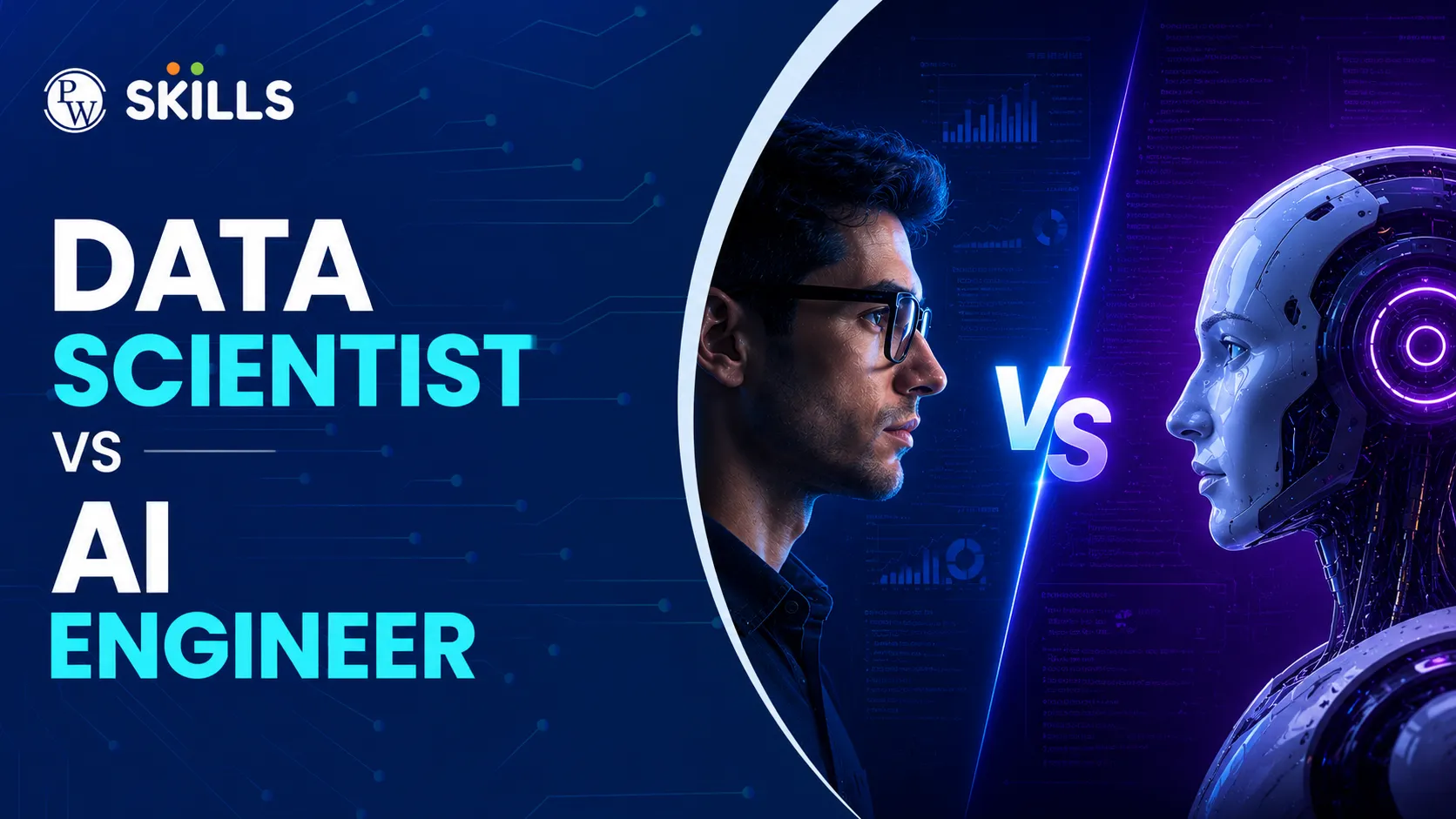
Striving for a career in today's technology world can seem like a maze, particularly when job titles are virtually the same. The "data scientist vs AI engineer" debate is undoubtedly something you've heard if you are a student or a professional aiming to join the field of intelligent systems.
This article will tell you about many technical details, skill sets, and career paths to help you determine which one best fits your strengths.
What Do a Data Scientist, and an AI Engineer Do?
In the world of data-driven and intelligent systems, we often confuse data scientists with AI engineers. Let's break it down: a data scientist is someone who works with statistics and machine learning techniques to analyse raw input (data), gain insights from it, build predictive models, and so on. On the other hand, an AI engineer is responsible for designing, developing and deploying scalable applications that incorporate those models into production.
If a data scientist is all about experimentation, finding patterns in the data, and model accuracy, then an AI engineer places greater emphasis on production-level systems, performance optimisation & infrastructure. Simply put, the data scientist decides what and why to build, while an AI engineer makes it work in practice. The two roles serve as counterparts and are both critical to designing a workable AI solution.
Difference Between a Data Scientist and an AI Engineer
The core difference lies in the stages of the product life cycle where these professionals work. The data scientist, as its name denotes, is a kind of "explorer". They work with unstructured and complex data, using statistical methods to extract trends that inform decision-making. They are the ones who need to prove that a given ML model can predict stock price movements or customer churn.
The AI engineer is a 'builder' in this case. After a data scientist generates a prototype model, an AI engineer adds the code to a real working application. They ensure the model works effectively – serving thousands of users at any time and keeping it as fresh in a live production environment as it was when training was not finished. An AI engineer spends more time in an IDE or cloud platform than a data scientist ever would in a Jupyter notebook. Below are the key comparison points:
-
Primary Objective: Data scientists want accuracy and insights; AI engineers want performance and scalability.
-
Data Handling: Data scientists undertake a wide range of data cleaning and exploratory data analysis (EDA) tasks. AI engineers are responsible for developing data pipelines and overseeing the infrastructure where models reside.
-
Programming Focus: Scripting for analysis is a common requirement in the programming focus of data science. AI engineering is more about developing code that is scalable, maintainable, and doable.
-
Outcome: The deliverable of a data scientist is usually a report, a dashboard or a model that has been tested. An AI engineer's work is a functional feature or software system that is powered by AI.
Skills Required for Data Scientist vs AI Engineer
These skill sets are very similar but with varying degrees of sophistication. Data science could be for you if you are into maths and narration. Those who appreciate system design and automation may be inclined towards AI engineering.
Data Scientist Skill Set
Below are the skillsets required for being a data scientist:
-
Statistics and Probability: This discipline is a foundational area of data science. To interpret data correctly, you must understand distributions, hypothesis testing, and regression.
-
Data Visualisation: Tools such as Tableau, Power BI, and libraries like Matplotlib and Seaborn are crucial for communicating results to stakeholders.
-
Programming: Must be proficient in Python or R, particularly in libraries such as Pandas, NumPy and Scikit-learn.
-
Domain Expertise: It is important to have some industry knowledge, such as finance, healthcare, or retail, to ask the right questions
AI Engineer Skill Set:
Below are the skillsets required for being an AI engineer:
-
Software Engineering: A deep understanding of algorithms, data structures, and object-oriented programming (OOP) is essential
-
Deep Learning Frameworks: Proficiency in PyTorch or TensorFlow is essential for creating complex neural networks.
-
Cloud Computing and DevOps: Knowing how to use AWS, Azure or Google Cloud and knowing Docker and Kubernetes is a massive plus when using AI models.
-
API Development: AI engineers need to learn to package models so that other software components can interact with them.
Roles and Responsibilities of a Data Scientist and AI Engineer
Consider an example that you can see in practice – creating a virtual assistant such as Alexa or Siri.
The Data Scientist’s Role:
They would listen to thousands of hours of sound and evaluate them. They would be responsible for developing Natural Language Processing (NLP) models to ensure the system understands multiple accents and slang. They would try various algorithms to determine which one had the lowest error rate in converting speech to text. Their "win" is a model of the one who correctly understands the user nine times out of ten.
The AI Engineer’s Role:
They take that 99% accurate model and ensure it responds in milliseconds. They develop the technology that enables the assistant to operate a smart speaker, a smartphone and the fridge at the same time. They run the cloud-based servers, which handle the voice information and make sure that the system doesn't crash when millions of people request the weather at the same time. Their "win" is the "pleasant and quick user experience.
One of them is generative AI. A data scientist could be someone who fine-tunes a large language model (LLM) to create poetry in a particular style. An AI engineer would create the interface, control API costs, and ensure that the AI model does not produce obscene material by establishing safety guardrails.



FAQs
1. Is the salary for a data scientist vs an AI engineer different?
2. Can a data scientist become an AI engineer?
3. Which role requires more coding?
4. Does an AI engineer need to know statistics?
5. Which career path is better for beginners?





Get Free Counselling Today
and Clear up all your Doubts
 Live & recorded classes available at easeDashboard for progress trackingLakhs of practice questions

