

The Most Common Mistakes Freshers Make While Learning Data Science
 Hardik Gupta10 Jul, 2026
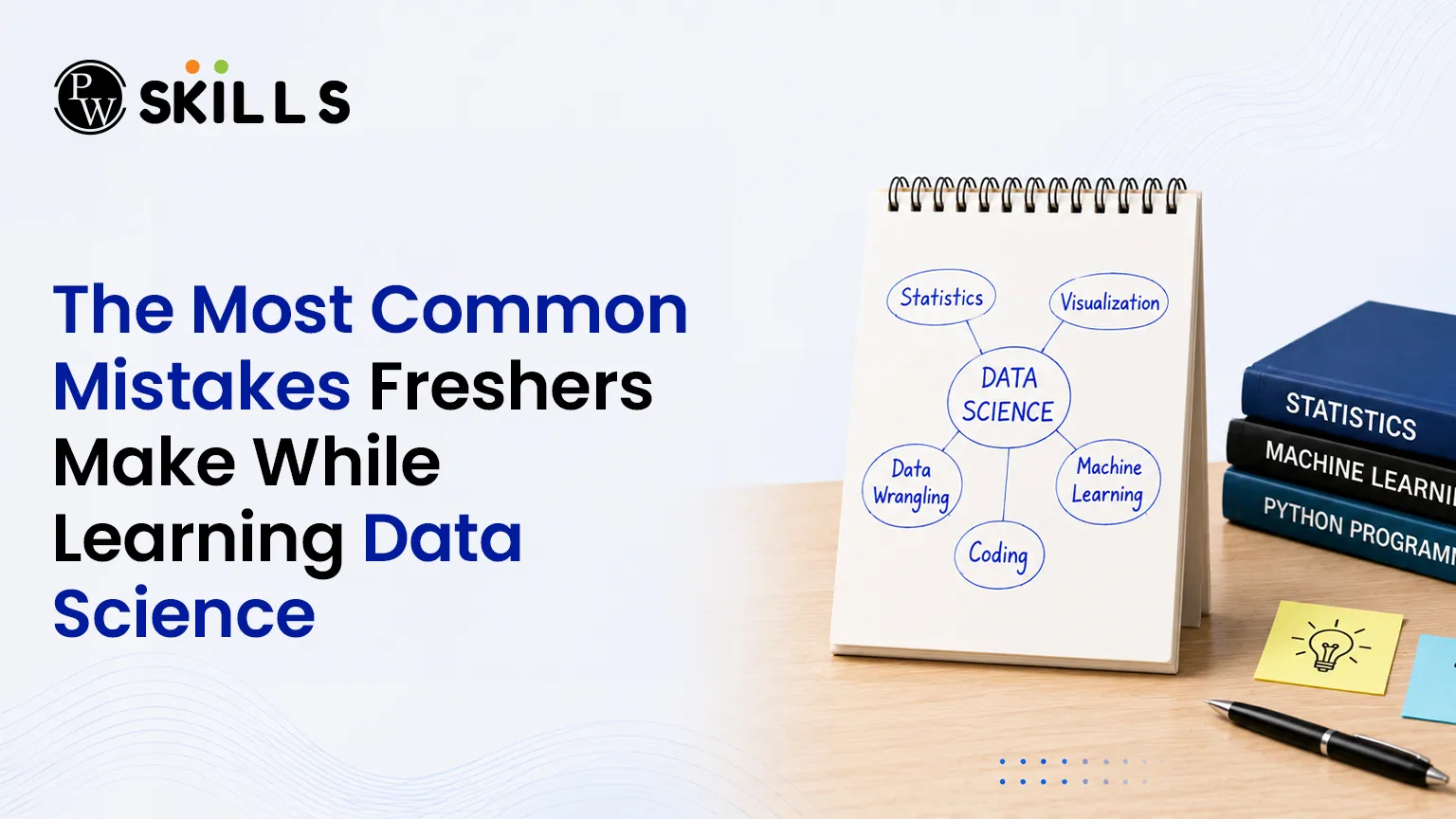
Analytics is an exciting prospect as a career, but many beginners find it difficult to get on the right track. They often get lost in a sea of programming languages, advanced tools, and endless online tutorials. This confusion leads to common data science learning mistakes that slow you down and lead to frustration.
Why Do Freshers Make Common Data Science Learning Mistakes?
There are many new people coming into the field with unrealistic expectations fuelled by industry hype. They see big pay cheques and fancy Ai apps and want to rush through the basics. But this enthusiasm often causes them to make fatal mistakes in their studying style.
Analytics is a vast area encompassing mathematics, programming, and business strategy. Freshers mug up everything at one go without proper guidance. This absence of structure leads to burnout and a poor understanding of how data actually works in the real world.
How Does a Data Science Roadmap Prevent Common Learning Mistakes?
A major error that freshers commit is diving into random topics without following a clear plan. Trying to learn Python, SQL, machine learning, and Tableau all in one week creates massive confusion and hinders real skill development.
-
Wasted time: Spending weeks on theoretical concepts that have little practical application.
-
Skill gaps: Missing foundational topics like linear algebra or basic data manipulation.
-
Lack of confidence: Feeling overwhelmed because the learning path has no clear milestones.
A proper data science roadmap acts as a step-by-step guide. It ensures you master one skill before moving to the next. The following table illustrates a balanced approach to structuring your learning journey effectively.
|
Phase |
Core Focus Area |
Key Tools & Skills to Master |
|
Phase 1 |
Foundations |
Mathematics, Descriptive Statistics, Excel |
|
Phase 2 |
Programming |
Python or R, Basic SQL Queries |
|
Phase 3 |
Data Handling |
Exploratory Data Analysis (EDA), Data Cleaning |
|
Phase 4 |
Machine Learning |
Regression, Classification, Model Evaluation |
Why Data Cleaning Is Essential for Learning Data Science
In tutorials, datasets are perfectly formatted and ready for modeling. In the real world, data is messy, incomplete, and full of errors. Freshers often neglect the data preparation phase because they find it boring compared to running machine learning algorithms.
Data professionals spend the majority of their time cleaning and transforming data. If you do not learn how to handle missing values, outliers, and incorrect data types, your machine learning models will produce inaccurate results.
-
Handling missing data: Learn when to drop rows or impute values using mean or median.
-
Managing outliers: Identify extreme values and decide how to treat them safely.
-
Feature engineering: Create new variables that help your model learn patterns more effectively.
Also Check: Data Cleaning: How to Clean, Components, Advantages, Benefits
Why Understanding Business Context Is Important for Learning Data Science?
Data science is not just an academic exercise in maximizing model accuracy. Its ultimate goal is to solve real business problems and help organizations make better decisions. Freshers often focus entirely on the technical metrics while ignoring the business objective.
A model with 95% accuracy is useless if it does not solve the specific problem the company is facing. You need to understand how your technical work translates into revenue, cost savings, or improved user experience.
-
Define the problem: Before coding, understand what business metric you are trying to improve.
-
Keep it simple: A simple, interpretable model is often preferred over a complex one if it makes sense to stakeholders.
-
Communicate clearly: Practice presenting your technical findings in plain English to non-technical managers.
How to Balance Theory and Practice to Avoid Data Science Learning Mistakes?
Many freshers spend months reading textbooks or watching video lectures without writing a single line of code. Theoretical knowledge is important, but data science is fundamentally a hands-on, practical discipline.
Conversely, some beginners copy and paste code from tutorials without understanding the math behind the algorithms. Both extremes hurt your career prospects. You must balance understanding how an algorithm works with knowing how to implement it on a messy dataset.
-
Apply immediately: Write code for every theoretical concept you learn.
-
Build projects: Move away from clean tutorial datasets and find raw data online.
-
Explain your models: Try explaining how a decision tree works to a non-technical person.
Why Overcomplicating Tools Is a Common Data Science Learning Mistake?
Many beginners think that if they want to be good at data science, they have to learn all the tools out there. They get certificates in different programming languages and software packages, thinking it will make their resume look impressive.
In reality, companies value great problem-solving skills over a long list of software tools. Mastering one language, like Python, along with SQL is much better than having a surface-level knowledge of five different languages.
-
Programming: Pick either Python or R and stick with it until you are fluent.
-
Data Retrieval: Learn SQL thoroughly, as data professionals spend a lot of time pulling data from databases.
-
Visualization: Master one tool like Power BI or Tableau to display your insights clearly.
How to Avoid Data Science Mistakes Before Learning Deep Learning?
It is natural to find neural networks and computer vision exciting. However, jumping straight into these advanced areas before mastering basic regression and classification is one of the most common beginner data science mistakes.
Advanced models are strongly dependent on basic ideas. If a complex deep learning model does not work, you will not be able to debug it or improve upon it, unless you understand linear regression, probability, and hypothesis testing.
-
Master linear models: Understand how linear and logistic regressions function.
-
Learn tree-based models: Study random forests and gradient boosting algorithms.
-
Evaluate properly: Learn how to use metrics like precision, recall, and F1-score correctly.




FAQs
Which programming language should a fresher learn first for data science?
Can I learn data science without a strong math background?
Why are my machine learning models performing poorly on real datasets?
How many projects should a beginner have in their portfolio?
Is it necessary to learn both Tableau and Power BI?






Get Free Counselling Today
and Clear up all your Doubts
 Live & recorded classes available at easeDashboard for progress trackingLakhs of practice questions

