

Best Python Libraries for Data Science, Machine Learning, and More
 Varun Saharawat30 Oct, 2025
Python is nearly universal. From apps that you open daily to AI models that disrupt industries, Python powers it all. But what makes it versatile is not just the language but everything around it—the Python Libraries.
Libraries are toolkits. You do not need to rewrite hundreds of lines of code but rather import a library and use functions that have been optimized by experts. This is why learning the best Python libraries for data science, machine learning, and deep learning is like receiving cheat codes to your career.
In this blog, we will review the Top 30 Python Libraries that every beginner, student, and working guy should know by 2025. Each library will be discussed in everyday language with examples as well as reasons why it should be part of your coding toolkit.

 Join Our Data Science Telegram Channel
 Join Our Data Science WhatsApp Channel
-
NumPy – The Base of Python Libraries for Data Science
NumPy is where data science with Python begins. Array is initiated, which is faster and more memory-efficient than Python offers lists. Think of the ability to crunch in seconds millions of numbers; this is what NumPy does.
You would use it to:
- Numerical dataset management
- Matrix operations
- Random value generation for simulations
For advanced users: If you are targeting a career in data science with flying colors, get acquainted with NumPy. It is almost a gateway to every other Python library for machine learning and statistics.
Time and easy data handling with Pandas
With all the Python Libraries, Pandas may be the most popular. It allows you to work with data in rows and columns using DataFrames and is, therefore, excellent for cleaning, organizing, and analyzing datasets.
For example, importing an Excel sheet with Pandas can be done in one line:
import pandas as pd
df = pd.read_excel("sales.xlsx")
Why it matters: Almost every single data science project begins with dumping messy data. Pandas makes cleaning a good stroll.
Matplotlib-The Visual Storyteller
Numbers are boring until they plot. Matplotlib is one of the well-known beginner Python libraries, as it aids in the visualization of datasets through charts.
From bar charts to scatter plots, it is your first step into Python libraries for data visualization. Students often use it in their projects to give a little more credibility to their reports.
Seaborn- Data Visualization with Style
Seaborn builds on Matplotlib but creates simpler, aesthetically more pleasing plots with less code. Want heat maps, violin plots, or statistical charts? Seaborn finds no difficulty with those.
Why students love it: In merely three lines of code, you can put together professional-level visuals.
SciPy: Advanced Scientific Computations
If you intend to go beyond rudimentary mathematics, SciPy is your pigeon. It is one of the mightiest Python libraries when it comes to seeking solutions to scientific and engineering problems.
Use cases:
- Signal processing
- Linear algebra
- Integration and optimization problems
It is heavily used by researchers and industries that require rigorous mathematical models.
Scikit-learn: Making Machine Learning SoEasy
If you can sum up Python for ML, it has to be Scikit-learn. It is the most famous library among beginners in machine learning from Python.
Providing ready-to-use functions for regression, classification, clustering, etc., Scikit-learn allows you to build ML model without getting immersed in heavy math-coding.
TensorFlow- Deep Learning Giant
TensorFlow is one of the best Python libraries for deep learning developed by Google. Image recognition, recommendation engines, and speech processing implementations are powered by this library.
Highlight: Scalability. From train your models in your laptop to seamlessly training those in Google cloud servers.
Keras: The User-friendly Neural Networks
Keras is a simplified version of TensorFlow. It is a friendly wrapper that permits beginners to create neural networks with less coding.
Reason to pay attention: Keras is very popular among students as it allows experimentation without the engulfing complexity.
Pytorch- An Adaptive Deep Learning Framework
Another star in Python libraries for deep learning, PyTorch was created by Facebook. It is also favored by researchers for its flexibility and easy debugging.
It is dominantly used in cutting-edge AI research in natural language processing (NLP).
Statsmodels: Statistical Backbone
Statsmodels concern classical statistics, whereas Scikit-learn is ML-oriented; thus, Statsmodels is about deeply statistical analysis.
- Time series forecasting
- Hypothesis testing
- Regression analysis
It is one of the important python libraries for data science students who want to understand "the why" behind the behavior of models.
Plotly: Interactive Visualizations
Plotly gives you interactive visualizations as opposed to static ones: hover over points, zoom in, create applications in real-time with data.
Great for: A professional dynamic presentation of results within a business environment.
Dash: Web Apps for Data Visualization
Based on Plotly, Dash allows you to convert Python scripts into web-based dashboards. Amongst the Python libraries list with examples, Dash stands alone as the bridge between code and design.
Visualize building a BI dashboard in a week, rather than in months-that's Dash.
NetworkX: Graph Theory in Action
Networks are all around us: social media, biology, supply chains, and more. NetworkX is a Python library aimed at the study of these networks, consisting of nodes and edges.
It is widely used in research, mainly for analyzing relationships and connections.
NLTK: A Natural Language Toolkit
For text analysis, NLTK is already one of the oldest Python libraries. It can tokenize sentences, remove stop-relating words, and even conduct sentiment analysis.
Students widely use it for projects on twitter data or customer reviews.
spaCy: Industrial, Lightning-Fast NLP
While NLTK is academic, spaCy is industrial. It is built for speed and for production use. Businesses favor spaCy to carry out tasks like chatbots and AI assistants.
In top of Python libraries for machine learning with texts, spaCy would be the first preference.
Transformers – Hugging-Face Magic
Hugging Face's Transformers library pretty much changed the way anybody will ever work with text or language data. Coding deep-learning models was a time-sucking task meant to be weeks of preparation and too much data with traditional libraries. With Transformers, you simply download a pre-trained model like BERT, GPT, or RoBERTa and perform tasks in just a couple of code lines.
Use cases:
- Sentiment analysis of tweets, reviews
- Automatic summarization of long documents
- Translation from one language to another
- Building intelligent chatbots and assistants
Example:
from transformers import pipeline
summarizer = pipeline("summarization")
print(summarizer("Python Libraries are vast and useful in data science, machine learning, and more.", max_length=20))
Why it matters: If you learn Python libraries for machine learning with text, Transformers is a must. It saves time, gives you access to state-of-the-art AI, and makes projects portfolio-ready for job applications.
BeautifulSoup – Web Scraping Made Easy
Data is not always neatly organized in CSV: it can be scattered across websites. And here comes BeautifulSoup, in one of the simplest Python libraries best suitable for the beginning, to parse an HTML or XML document expertly.
Use cases:
- Scraping product details and reviews from e-commerce sites
- Collecting headlines from news portals
- Extracting data tables from websites for analysis
Example:
from bs4 import BeautifulSoup
import requests
url = "https://example.com"
html = requests.get(url).text
soup = BeautifulSoup(html, "html.parser")
print(soup.title.text)
Why students love it: It is beginner-friendly and, when paired with Requests, provides the base for countless fun mini research projects. Given this, BeautifulSoup certainly has to go onto your list of Python libraries with examples.
Requests – The HTTP Library
Interacting with webpages is always the first step before web scraping or communicating with web APIs. Requests hands you over the tool you need here. It is the quickest DLL among all Python Libraries.
Use cases:
- Fetch web pages to scrape
- Interact with REST APIs for JSON data
- Automate Downloads (PDFs, images, or datasets)
Example:
import requests
response = requests.get("https://api.github.com")
print(response.status_code) #200 Means Success
Why it matters: For beginners, Requests has branches just for scraping websites; at the same time, experts find it heightening their projects with API automation every other week.
OpenCV – King of the Hill in Computer Vision
Imagine teaching your machine to see—it can with OpenCV (Open Source Computer Vision), one of the best libraries. It has the capability for image processing to make machines recognize visual data in Python.
Use cases:
- Face recognition in cameras and apps
- Detect objects in real-time video streaming
- Processing medical images (like X-rays and MRIs)
- Using AR/VR applications
Example:
import cv2
img = cv2.imread("image.jpg")
gray = cv2.cvtColor(img, cv2.COLOR_BGR2GRAY)
cv2.imshow("Grayscale", gray)
cv2.waitKey(0)
cv2.destroyAllWindows()
Why it’s powerful: OpenCV is omnipresent. From Snapchat filters to self-driving cars, it’s everywhere. If your heart is set on computer vision, start mastering this Python library.
Pillow – Image Processing Library
Pillow is lightweight and easy compared to OpenCV, which in itself is a very great advantage for beginners eager to experiment with images. It’s a modern fork of the old PIL (Python Imaging Library) and is, therefore, widely used in projects where basic image editing is required.
Use cases:
- Resizing and cropping photos
- Applying filters and watermarks
- Converting images between formats (like JPEG, PNG, etc.)
Example:
from PIL import Image
img = Image.open("photo.jpg")
resized = img.resize((200, 200))
resized.save("resized_photo.jpg")
Why it matters: Certainly, among the favorite libraries of beginners that are into examples, Pillow comes forth in terms of being fun and hands-on by way of image manipulation without much ado concerning complex vision algorithms.
Django – The Development Framework for the Web
Python is as much a web language as for data. Django is the heavyweight among the web development frameworks in Python. It adheres to the philosophy of “batteries included,” meaning out of the box, it has user authentication, database access, and security modules.
Use cases:
- Building e-commerce websites
- Developing secure enterprise-level web apps
- Backend Dev for social media outlets
Example (starting a project):
django-admin startproject mysite
Why it is loved: Instagram, Pinterest, and Disqus heavily rely on Django. And if you are willing to step out of scripts and enter professional web-app territory, there’s nothing better than working with Django among Py libraries.
Flask – Lightweight Web Framework
Django is the all-in-one power, while Flask is actually a minimalist toolkit. It is probably the most popular Python library for beginners who are interested in web development because it's easy to learn, flexible and doesn't fit people too much into a narrow mold-just the way it likes it.
Use cases:
- Quick prototyping and building lightweight web app
- Creating REST APIs in a fast fashion
- Learning the fundamentals of backend development before actually plunging into Django
Example:
from flask import Flask
app = Flask(__name__)
@app.route('/')
def hello():
return "Hello, Flask!"
if __name__ == '__main__':
app.run()
Why it matters: Startups adore using Flask because of its fast prototyping. It is also a good way towards progression for students from scripts into real web applications.
FastAPI – Modern Web APIs
APIs are the backbone of the present digital era and FastAPI is touted to be the modern framework. It also flaunts speedier advantages than Flask, which automatically generates documentation via OpenAPI and swagger.
Use cases:
- API for machine-learning models
- Construct large-scale microservices
- Backend systems for production applications
Example:
from fastapi import FastAPI
app = FastAPI()
@app.get("/")
def read_root():
return {"Hello": "World"}
Why developers love it: Fast, easy to use, and async-ready. FastAPI is the modern choice when you want your Python libraries for machine learning models working live in an application.
PyGame – Game Development Made Fun
Coding doesn't always have to be serious. PyGame is considered by many as one of the most fun to learn Python libraries because it lets you program 2D games. Students use it for projects involving making clones of Tetris, Pong, or Snake.
Use cases:
- Projects for educating the way in loops and events
- Making very simple 2D games
- Making interactive 2D simulations used for teaching
Example:
import pygame
pygame.init()
screen=pygame.display.set_mode((400, 300))
pygame.display.set_caption(constant_val2["Hello PyGame"])
running=True
while running:
for event in pygame.event.get():
if event.type==pygame.QUIT:
running=False
pygame.quit()
Why it matters: PyGame brings creativity to coding- not just games, but also best problem-solving and logic in play teaching.
XGBoost - Winning ML Competitions
If there was a library that Kaggle were to favor, it would be XGBoost (Extreme Gradient Boosting). One of the best machine learning Python libraries is because of speed, scalability, and efficiency in tabular data handling.
Use cases:
- Predict customer churn in companies
- Credit scoring in banks
- Forecasting stock prices
Why it is important: Models designed using XGBoost often outperform other models based on deep learning on structured datasets. Hence, for students, it is a must-learn to win ML hackathons and competitions.
LightGBM - Gradient Boosting at Scale
The LightGBM model has been developed by Microsoft just like the XGBoost model, but the difference is updated speed and optimized performance over large datasets. It uses a "leaf wise" growth strategy that improves accuracy while not slowing things down.
Use cases:
- Financial modeling on a large scale
- Predict click-through rates for ads
- Big data projects works better when performance is key
Why it matters: In terms of python libraries for machine learning, LightGBM is your friend when the datasets are huge even as training time is short.
CatBoost - Savior for Categorical Data
Categorical data (yes/no, red/blue, or names of countries) is often a nightmare when it comes to modeling. CatBoost, created by Yandex, manages it automatically without any complex preprocessing.
Use cases:
- Marketing analytics (customer segmentation)
- Fraud detection systems
- Recommendation engines
Why students love it: Unlike the libraries of other Python libraries, you do not have to spend hours encoding variables; it is all done automatically by CatBoost.
PyCaret - AutoML Library Python Libraries
Not everyone wants to write the machine learning algorithms from scratch. PyCaret is an AutoML library that does everything from preprocessing the data, training a model, and even hyperparameter tuning, in very little code.
Use cases:
- Rapid development of ML models
- Comparison of several algorithms all in one go
- Teaching beginners how models carry out their tasks without coding complexities
Example:
from pycaret.datasets import get_data
from pycaret.classification import *
data = get_data('diabetes')
s = setup(data, target='Class')
best_model = compare_models()
Why it matters: For beginners and busy professionals, PyCaret is life saving. It's sort of a shortcut into the machine learning libraries of Python while still producing quality results.
SymPy - Symbolic Mathematics Python Libraries
Math-letics fans take notice! This is a library developed to do algebra, calculus, and equations in Python-almost like having a digital mathematician.
Use cases:
- Simplify equations
- Integrate and derive
- Make formulas for physics or engineering
Example:
from sympy import symbols, solve
x = symbols('x')
equation = x**2 - 5*x + 6
solution = solve(equation, x)
print(solution) # [2, 3]
Why it's cool: For students that are preparing for examinations, SymPy can double as a tutor for math. For engineers, it automates hours of calculations they would have done by hand.
Scrapy - Advanced Web Scraping Python Libraries
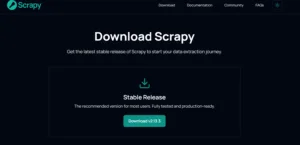
While BeautifulSoup is great for small projects, Scrapy was engineered for web scraping on a massive scale. It is fast, efficient, and capable of crawling multiple pages across entire websites.
Use cases:
- E-commerce data scraping (prices, products, reviews)
- Job portal scraping for listings
- News aggregator tools
Why it matters: Out of your list of Python libraries with examples, Scrapy stands out as the professional choice for data collection. It is widely used in industry for research and data pipelines.
Learn Data Science the Way It Ought to Be Taught with PW Skills
If serious about mastering Python Libraries for real-world applications, the PW Skills Data Science curriculum is bound to be your launching pad into the world. From NumPy and Pandas to TensorFlow and PyTorch, the course imparts knowledge, practical experience, and mentorship project engagement. Whether you're a student or a working professional, you leave the program with the confidence required to solve real-world problems.



FAQs
How do Python Libraries save time for developers?
Which Python Libraries are best for visualization?
What Python Libraries showcase the best trends in 2025?
Are Python Libraries free to use?





Get Free Counselling Today
and Clear up all your Doubts
 Live & recorded classes available at easeDashboard for progress trackingLakhs of practice questions

