

Correlation Analysis: Definition, Examples, Applications, and Complete Guide
 Varun Saharawat30 Oct, 2025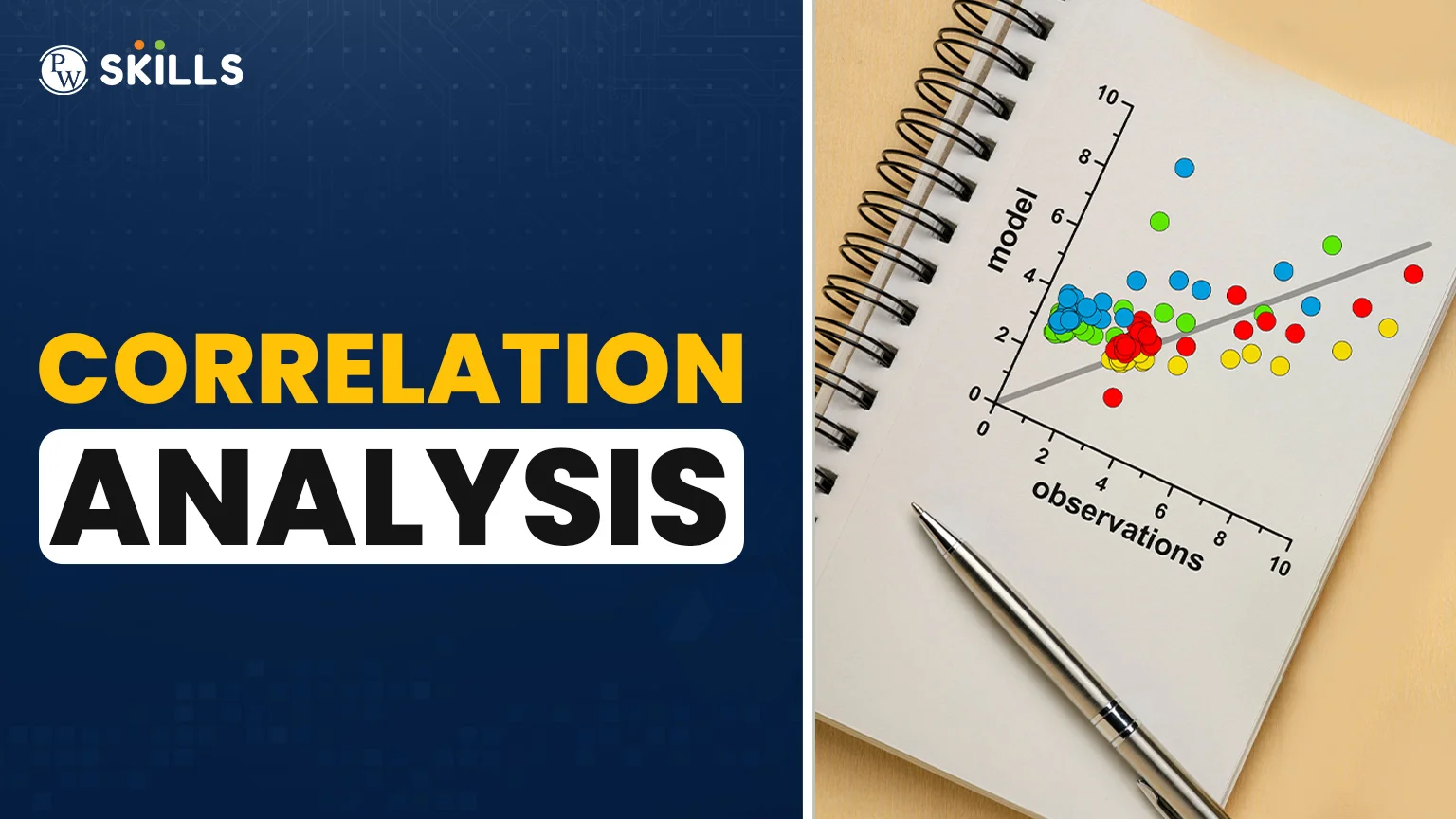
Imagine yourself with a steaming cup of coffee, scrolling through your fitness app, and then suddenly spotting an irregularity. The more you run, the better you sleep, or at least that's the feeling you get. Coincidence? Maybe. However, if you want to prove it, you need a statistical tool: enter Correlation Analysis, the Sherlock Holmes of data science that helps to uncover invisible links or relationships between two or more variables.
A student just tasting statistics, or a working person analyzing sales trends, or a researcher trying to map the data of the climate-all can develop a liking for, learn to use, and apply correlation analysis. In this blog, let's talk about it-to-and-fro: definitions, examples, applications, coding snippets, career opportunity realizations, and, frankly, mistakes to avoid.
Fasten your seatbelt: this will be your one-stop guide to acquiring the skills of correlational analysis.
What Is Correlation Analysis?
Put simply, Correlation Analysis is a statistical method to assess the strength and direction of a relationship between two variables. It is something like this: with the rise of variable A, does variable B rise as well? Or does it go down? Or do they independently exist, just like strangers in a party ignoring each other? The result of the analysis is usually a number between -1 and +1, which is called the correlation coefficient. +1 → Perfect positive correlation (they go together like synchronized swimmers). -1 → Perfect negative correlation (they go in opposite directions, just like Tom and Jerry). 0 → No correlation (they mind their own business).Example of Correlation Analysis in Real Time
It is better to make concrete.- Business Example: A company examines whether expenditure on advertisements is correlated to the revenue made through sales.
- Education Example: A teacher wonders whether the number of hours spent studying affects an individual student's exam score.
- Health Example: Doctors may ask whether smoking and lung cancer are related.
Difference Between Correlation and Regression Analysis
Often, correlation analysis gets mixed up with regression analysis. They may be cousins but not twins.- Correlation Analysis → Measures the strength and direction of a relationship between two variables.
- Regression Analysis → Goes a step further. It predicts the value of one variable based on another.
How to Perform Correlation Analysis
Now let's dig in. Correlation studies normally follow these few well-defined processes:Step 1: Collection of Data
You will need two data sets; for instance, advertising spend and revenue over 12 months.Step 2: Select the Correlation Method
Pearson's correlation (the most used; applies to continuous data). Spearman's rank correlation (for ranked or ordinal data). Kendall's tau (for smaller samples with ties in ranking).Step 3: Calculate Coefficient
You may do so through several tools such as Excel, Python, R, or even simple calculators.Mini Coding Example in Python
import pandas as pd # Sample data data = { 'Study_Hours': [2, 4, 6, 8, 10],'Scores': [55, 65, 75, 85, 95]} df = pd.DataFrame(data) # Correlation correlation = df['Study_Hours'].corr(df['Scores']) print("Correlation Coefficient:", correlation) This will turn something close to 1.0, meaning to say very strong positive correlation.Step 4: Interpret Results
Close to +1 → strong positive relationship Close to -1 → strong negative relationship Close to 0 → weak or no relationship.Applications of Correlation Analysis
Most academic toys are being used in real industries.Business and Marketing
Companies analyze correlations between costs in ad campaigns and engagement by customers, or between application of discounts and sales.Finance
These investors study the correlation between stocks, each having as investment a number of stocks in the diversified portfolio. If stock A and stock B show a substantially high correlation, the risk goes higher by investing in both.Healthcare
Theoretically, doctors study whether simple lifestyle factors such as what are eaten in a person's diet or something as basic as exercise can cause possible health outcomes.School
Does attendance correlate with output at school?Technology and AI
All machine learning systems start with correlation analysis for discarding those features deemed redundant by the model.Advantages of Correlation Analysis
- Simple and Easy: Understandable and easy to apply within a short period.
- Widespread Applicability: Typical of many domains: psychology to engineering.
- Foundation for More Advanced Methods: Poster prepares data for regression and machine learning.
- Uncover Certain Insights Hidden: Point out links that are not obvious.
Disadvantages of Correlation Analysis
Correlation does not equal causation. Just because two variables are related does not mean the first causes the second. For instance, both ice cream sales and drowning cases might increase during summer; yet, in reality, eating ice cream does not cause drowning.- Pearson correlation misses non-linear patterns.
- They focus on extreme cases of data. They alter the results.
 Join Our Data Analytics Telegram Channel
 Join Our Data Analytics WhatsApp Channel
Common Errors in Correlation Analysis
- Assuming Correlation Means Causation
- Ignoring Outliers
- Small Sample Sizes
- Variable Types
- Overinterpreting Weak Correlations
Roadmap: How to Learn Correlation Analysis
Step 1: Build up Statistical Foundations Learn basics like forecast, variance, and standard deviation. Step 2: Understand Types of Correlation Study positive correlation, negative correlation, and zero correlation. Step 3: Get Practical on Excel or Google Sheets Apply the CORREL function as a shortcut for calculations. Step 4: Go Over to Python or R Understand Pandas, NumPy, and SciPy in Python or the correlation functions in R. Step 5: Do Some Mini Projects Examine datasets such as sales vs. advertising or hours studied vs. grades. Step 6: Proceed to Regression and Machine Learning Use the correlation analysis as a segue for predictive models.Real-Life Mini Project Idea
Study: Find out the social media usage hours are correlated to academic performance.- Gather data from your classmates (time on social media vs. exam scores, etc.).
- Conduct a correlation analysis in Excel or Python.
- Visually present your findings in scatter plot format.
Career Options and Salary Insights
Since correlation analysis is a basic skill, a lot of careers rely on it, such as:- Data Analyst
- Business Analyst
- Market Researcher
- Financial Analyst
- Data Scientist
- Data Analyst: ₹5–8 LPA
- Business Analyst: ₹6–10 LPA
- Data Scientist: ₹10–20 LPA
Why We Need to Know Correlation Analysis
For Informed Decisions
The method gives a way for businesses, health, finance, etc. professionals to develop their strategies based on data.For Not Guessing
It gives measurable reasoning as opposed to just assumption.For Finding Patterns
It finds unexpected links between two variables, mostly overlooked by intuition.To Build Faith in Predictions
Bases prediction on regression, forecasting, and ML models. For Associational Navigation in a World Guided By Data Must-have skill for all students and professionals and researchers working with numbers daily.Correlation Analysis vs. Other Tools
- Correlation vs. Causation→ Correlation indicates links, while causation proves the impact.
- Correlation vs. Regression→Regression is predictive; correlation is descriptive.
- Correlation vs. Covariance-Covariance assesses how variables move, while correlation standardizes it on a scale of -1 to +1.
Troubleshooting Guide Stepwise
- If correlation is surprisingly high, check for outliers.
- If correlation is low but you expected a relationship, check for non-linear patterns.
- Always employ scatter plots for visual representation before making any interpretation.
- Choose different correlation methods based on the data type you are working on.
Also Read:
PW Skills Data Analytics Course: Your Next Step
Want to learn everything about Correlation Analysis and other data skills? The PW Skills Data Analytics course provides a hands-on industry-ready syllabus. Over six months, you'll get from an amateur to a pro, with real-world projects, cost-efficient training, and expert guidance. It is fit for anybody who is either still a student or working a job but wants to transition into a career in data.




Correlation Analysis FAQs
What is Correlation Analysis used for?
Can correlation prove cause and effect?
Which tools are best for correlation analysis?
Is correlation analysis hard to learn?





Get Free Counselling Today
and Clear up all your Doubts
 Live & recorded classes available at easeDashboard for progress trackingLakhs of practice questions

