

Build a Startup Revenue Projection Model in Excel
 Varun Saharawat22 Jun, 2026
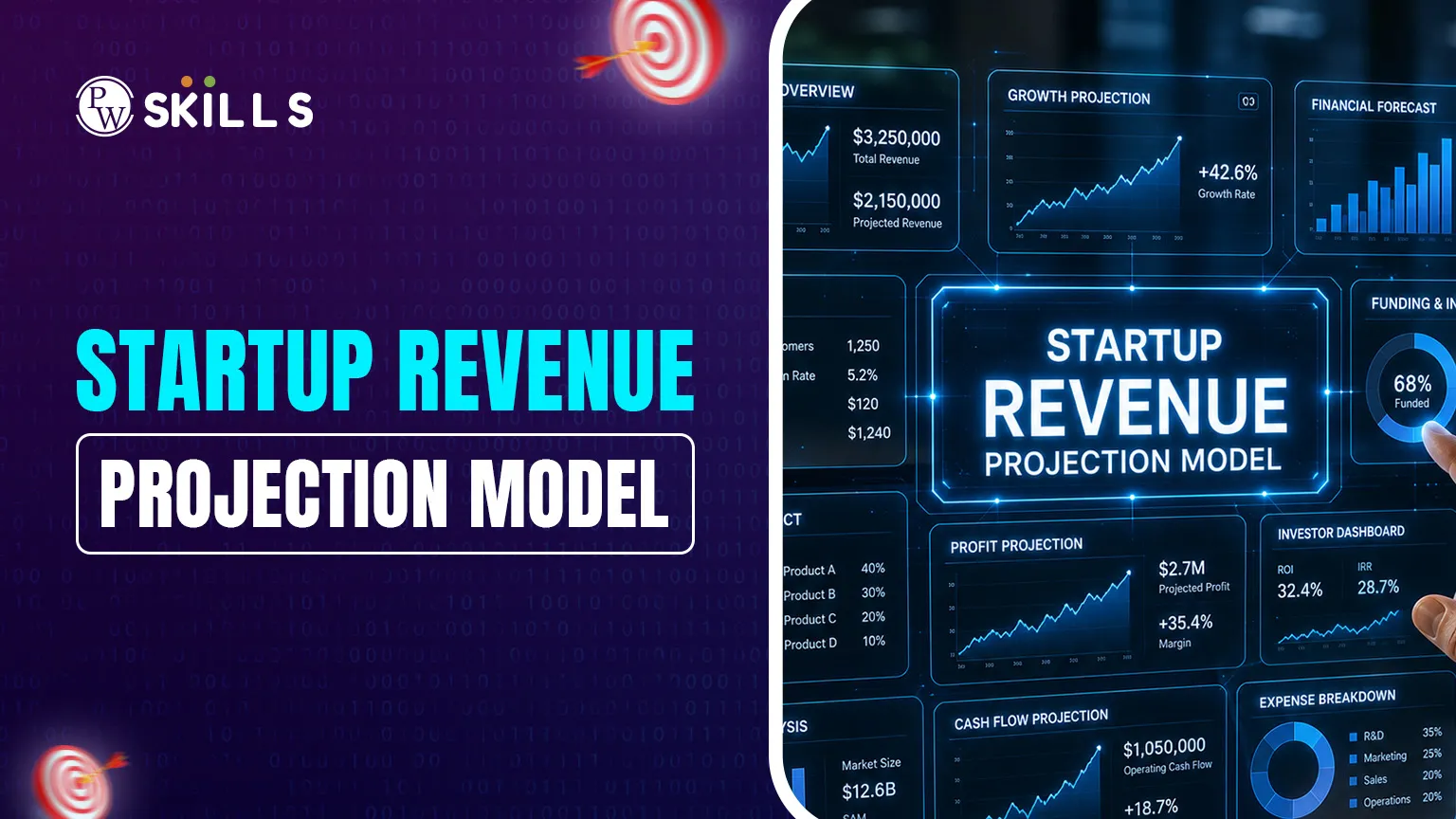
\For many new founders or data analysts, predicting the future can feel like throwing darts in pitch-black darkness. Building a startup revenue projection model is less about seeing the future and more about understanding how your business works. Backing for an investor pitch or controlling internal resources – your financial forecasts are a guide.
This article explains how revenue forecasting can be broken down into simple steps, allowing you to build on your framework as your startup grows.
What is the Startup Revenue Projection Model?
A revenue projection model is a structured approach to forecasting an organisation's likely revenue over the next 3 to 5 years. This model is just part of a larger business plan for startups. Startups do not have the historical data available to established corporations from years past; they must build their forecasts based on market research, early-stage metrics, and rational assumptions.
In a revenue projection model for startups, the two most common methodologies are:
-
Top-Down Forecasting: With the top-down approach, you start with TAM (total addressable market) and estimate what portion of that segment the startup is targeting to capture. Although it can be useful as a way of demonstrating the possible, this method is often where simply projecting numbers onto reality results in unceremoniously large figures.
-
Bottom-Up Forecasting: Given to be more accurate and reliable in general. It focuses on internal capacity, such as the number of units produced since the beginning or the number of sales calls one can make in a month, by examining metrics that measure the cost of acquiring one customer.
Components of Startup Revenue Projection Model
If you want to make your model professional, you should use certain independent variables that demonstrate, 'Hey man, we understand how our whole industry works.' These are the main elements you need to include.
-
Sales Volume: The quantity of items sold or services rendered. It is the primary engine behind your entire financial forecast.
-
Pricing Tiers: If you have multiple service tiers (e.g., Basic, Pro, Enterprise), they should be line items so you can see how your "product mix" impacts total revenue.
-
Customer Acquisition Cost (CAC): This is the cost of marketing and sales to acquire a single customer. This is an essential measure in startup financial forecasting.
-
Churn Rate: For subscription-based models, this is the percentage of customers who cancel their service each month. High churn can kill a company even if the new sales are exceptional.
-
Average Order Value (AOV): This indicates how much a customer spends on average per order.
-
Retention Rate: The reverse of churn, having your customers stick around over time, is important for long-term sustainability.
-
Market Share Percentage: It's a "sanity check" metric that demonstrates what percentage of the entire industry you are asserting to dominate.
How to Create a Startup Revenue Projection Model
Creating a financial model requires you to be systematic in outlining the steps and flows from raw assumptions to final totals. Steps to Follow in Building Your Model in Excel:
1. Define Your Timeframe and Frequency
For most startups, you should project your financials for at least 3 years. The first year is better treated as a month-by-month forecast rather than an annual one, which accounts for the impact of seasonality and early-stage fluctuations. You can show the second and third years in total, either quarterly or annually.
2. Gather Historical Data and Market Research
Use your baseline data from the past few months if it has existed that long. If pre-revenue, use industry benchmarks. Notable data points include the following:
-
Price per unit or service sold on average.
-
Market growth rates.
-
Competitor pricing structures.
3. Establish Growth Assumptions
Tab in Excel for the 'Assumptions'. This separates your variables and formulas, making 'what-if' analysis more manageable. Calibrate your growth or customer acquisition model (e.g., 5% MoM) along with the churn rate.
4. Build the Revenue Streams
Find out what you make money from. Are you a subscription SaaS company, a one-off product, or a service?
-
For Subscriptions: (New Customers + Existing Customers — Churn) * Monthly Fee.
-
For Products: Total Dealer Price (Units Sold) x (Price Per Unit).
5. Validate with a Bottom-Up Check
After calculating your totals, you might ask, 'Do we have enough personnel prepared to handle this many sales?' If your pirate model says you will sell 1000 but have one salesman, then the financial forecasting is incorrect.
Benefits of Startup Revenue Projection Model
This scenario raises the question: why do founders spend hours in Excel just trying to get these numbers right? The advantages go far beyond simply demonstrating to a potential investor.
-
Strategic Resource Allocation: A model indicates when you will have excess cash available to recruit new talent, or when cuts are necessary.
-
Attracting Investors: Venture capitalists look for 'pragmatic ambition'. When you build a revenue projection model for your startup, it shows that you know what you're getting into and how to win the fight.
-
Setting Performance Benchmarks: Benchmark against the "actuals" (what actually happened) and your "projections", then use this information to find out where you are underperforming or overperforming in your business.
-
Risk Mitigation: Financial modelling enables you to carry out 'worst-case' scenario simulations. You've done terribly — sales are down 20% over the estimates you put in your plan (which were already conservative). How long can you survive on this level of cash? Knowing the answer early can save your company from bankruptcy.
-
Operational Clarity: Your leadership team must commit to specific prices, customers, and other factors; this alignment ensures everyone is moving in the same direction.





FAQs
1. What is the difference between top-down and bottom-up revenue projections?
2. How often should a startup update its revenue projection model?
3. Why is Excel preferred for startup financial modelling?
4. Can I build a revenue model if I have zero historical data?
5. What is a "good" growth rate to include in my projections?





Get Free Counselling Today
and Clear up all your Doubts
 Live & recorded classes available at easeDashboard for progress trackingLakhs of practice questions

