
What Are The Basic Programming Fundamentals For Software Development?
Become an efficient programmer or web developer by starting with programming fundamentals. It consists of imports, functions, libraries, data types, syntax, compilers, and more.
 Varun Saharawat30 Oct, 2025
Programming fundamentals are used to guide the process of the software development life cycle. Most of the programming basics and fundamentals are used worldwide and are accepted as a token of standardisation which is followed by top programming languages.

Differences exist in the different programming languages but most of them are that programming fundamentals are almost similar in every language. In this article, let us become familiar with some of the programming fundamentals and learn how to excel in programming.
Also Read: Basic PHP Syntax: Features, History, Variables And Embedding
🧐 Click here to know 🗞️
9 Programming Fundamentals To Excel In Programming
 Getting familiar with programming fundamentals is very important to excel in coding skills and web development. Let us know some of the major programming fundamentals. We will be using C++ for examples ahead in this article.
1. Import Libraries
The first step in major programming languages is importing libraries in the file related to the project. It is a process of including pre-written code or functions in your program to reuse the existing functionality without rewriting code from scratch. Libraries in programming languages are collections of modules, classes, functions, methods, etc used to perform specific tasks such as computation, manipulation, file handling, and web development.| #include <iostream> //standard library #include <vector> #include <strings> #include <algorithm> #include <map> #include <fstream> #include <cmath> #include <cstdlib> |
2. Variable Declaration
Variable declaration is the second most important step in programming fundamentals where a memory location is decided based on the data type for a variable. Variables can be declared with an identity or keyword based on the programming language syntax. Most programming languages include variables with numbers, alphabets, and special characters. Variables can be used to store values of any data type supported by the programming language. In C++, some of the major things must be kept in mind while declaring variables.| Data Type | Size (bytes) | Range |
| int | 4 | -2,147,483,648 to 2,147,483,647 |
| unsigned int | 4 | 0 to 4,294,967,295 |
| short | 2 | -32,768 to 32,767 |
| unsigned short | 2 | 0 to 65,535 |
| long | 4 (or 8) | -2,147,483,648 to 2,147,483,647 (or larger) |
| long long | 8 | -9,223,372,036,854,775,808 to 9,223,372,036,854,775,807 |
| float | 4 | ±3.4E-38 to ±3.4E+38 |
| double | 8 | ±1.7E-308 to ±1.7E+308 |
| long double | 10, 12, or 16 | More precision than double |
| char | 1 | -128 to 127 (signed) or 0 to 255 (unsigned) |
| bool | 1 | true or false |
| wchar_t | 2 or 4 | Implementation-defined range |
| void | 0 | N/A |
| nullptr_t | Implementation-defined | N/A |
3. Programming Basic Syntax
Every programming language consists of its own set of rules and guidelines also known as “syntax”. It is important to learn a programming language's syntax before starting to code in a particular language. We need to be aware of the syntax of a programming language to read the coded part of a program. We can understand the uses of syntax with a simple Hello World! program.| #include <iostream> using namespace std; // avoid using 'std::' before standard library names int main() { cout << "Hello, World!" << endl; // Output the message to the console return 0; // Indicate successful program termination } |
4. Data Types
Data Types are used to represent the classification of data such as string, integer, floating, boolean, numbers, characters, arrays, etc. Data types are supported in every programming language. However, the fundamentals of data types are decided by the programming language itself.Basic Data Types in C++
| Category | Data Type | Size (bytes) | Range |
| Basic Types | int | 4 | -2,147,483,648 to 2,147,483,647 |
| unsigned int | 4 | 0 to 4,294,967,295 | |
| short | 2 | -32,768 to 32,767 | |
| unsigned short | 2 | 0 to 65,535 | |
| long | 4 or 8 | Platform-dependent | |
| unsigned long | 4 or 8 | Platform-dependent | |
| long long | 8 | -9,223,372,036,854,775,808 to 9,223,372,036,854,775,807 | |
| unsigned long long | 8 | 0 to 18,446,744,073,709,551,615 | |
| float | 4 | ±3.4E-38 to ±3.4E+38 | |
| double | 8 | ±1.7E-308 to ±1.7E+308 | |
| long double | 10, 12, or 16 | Platform-dependent | |
| char | 1 | -128 to 127 (signed) or 0 to 255 (unsigned) | |
| bool | 1 | true or false | |
| wchar_t | 2 or 4 | Implementation-dependent | |
| void | 0 | N/A |
Derived Types
| Category | Data Type |
| Pointer | type* |
| Reference | type& |
| Array | type arrayName[size] |
| Function | returnType func() |
User Defined Data Types
| Category | Data Type |
| Enumeration | enum |
| Structure | struct |
| Class | class |
| Typedef/Using | typedef, using |
| Union | union |
5. Data Structures and Algorithms
There are many data structures available in a programming language that can be used to include operations enabled for data. It can be used to store, organize, and manage data quickly. In C++ data structures are enclosed with STL (Standard Template Library). Some of the popular data structures are arrays, linked lists, stacks, heaps, trees, tables, queues, graphs, etc.| Data Structure | Import Header | Features |
| Array | No special header required |
|
| Vector | <vector> |
|
| Deque | <deque> |
|
| List | <list> |
|
| Stack | <stack> |
|
| Queue | <queue> |
|
| Priority Queue | <queue> |
|
| Set | <set> |
|
| Unordered Set | <unordered_set> |
|
| Map | <map> |
|
| Unordered Map | <unordered_map> |
|
| Multiset | <set> |
|
| Multimap | <map> |
|
| Bitset | <bitset> |
|
| Forward List | <forward_list> |
|
| Heap | <queue> (for priority queue) |
|
| String | <string> |
|
6. Flow Structures
Flow structures are important in programming fundamentals where a programmer must be aware of how they will proceed in writing the programs apart from the logic build. The flow structure generally comprises a starting phase, sequential, selection (conditionals), and iteration (loops).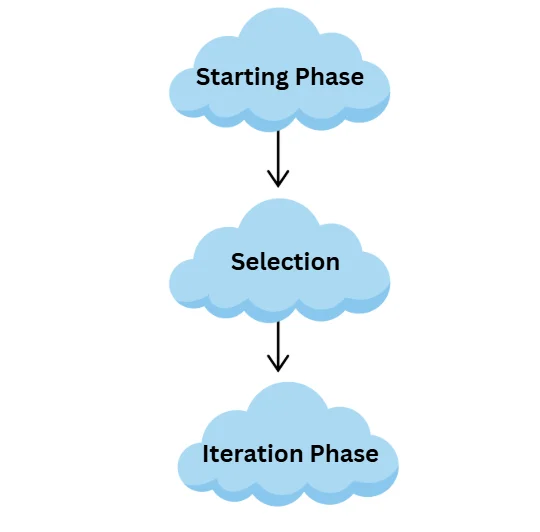
Selection & Iteration
The selection consists of conditional statements where a condition is evaluated and action is performed based on boolean values i,e. True or false. In the Iteration phase, loops are used to execute a block of code repeatedly until a specific stopping condition. The loop is eliminated when the given condition fails to be satisfied.7. Object Oriented Programming
One of the most important programming fundamentals is Object Oriented Programming language. Most of the languages nowadays have built-in support for OOPs. OOps consists of objects and classes and works on major four principles i,e. Inheritance, encapsulation, abstraction, and polymorphism.8. Debugging
Debugging is an important skill in programming where you must be able to perform debugging to detect and remove existing errors rising in your program due to various reasons. There are many debugging tools also available nowadays with most compilers.9. Programming Environment
IDEs and compilers are used to write and organize code. It also helps increase programmers' efficiency and productivity. These IDEs provide many features such as auto code completion, debugging, syntax suggestions, highlights, etc. Some of the popular IDEs are VS Code, NetBeans, Eclipse, Jupyter, PyCharm, Xcode, etc.Learn C++ Programming with PW Skills
Get interactive tutorials, real world programming problems, data structures, and algorithms within this self paced Decode DSA with C++ Course. Practice with exercises and module assignments throughout the course covered by dedicated mentors. Get certified after completing the program only on pwskills.com



Programming Fundamentals FAQs
Q1. What is a programming language?
Ans: A programming language is a formal set of instructions used to communicate with a computer to perform specific tasks. It allows developers to write programs that control the behavior of machines and create software applications.
Q2. What are the basic components of programming fundamentals?
Ans: Most programming basics components of programs are
Variables are used to store data.
Control Structures consist of loops (for, while) and conditionals (if, else) to control the flow of execution.
Functions contain reusable blocks of code for modularity.
Input/Output are mechanisms for interacting with the user or files.
Data Structures consist of arrays or lists to organize data.
Q3. What is an algorithm?
Ans: An algorithm is a step-by-step procedure or formula for solving a problem. It serves as the foundation of programming.
Q4. What is the difference between Syntax and semantics in programming?
Ans: Syntax refers to the rules and structure of how code is written in a programming language. Semantic refers to the meaning or logic of the code. For example, missing a semicolon in C++ will cause a syntax error.


Talk to a counsellorHave doubts? Our support team will be happy to assist you!



Get Free Counselling Today
and Clear up all your Doubts
Talk to Our Counsellor just by filling out the form.
Join 15 Million students on the app today!
 Live & recorded classes available at easeDashboard for progress trackingLakhs of practice questions

