
What is the Program of C?
"What is the Program of C?" refers to a set of instructions written in the C language to perform specific tasks. C programs demonstrate logic through functions, variables, loops, and conditions, serving as the foundation for system-level and application development.
 Varun Saharawat30 Oct, 2025
A Prime number is a number that is divisible by itself or by 1, such as 2, 3, 5, and so on. In this article, we will learn different ways to write a C program for checking whether a given number is prime or not.
When you're starting out, it's not just important to write code but also to understand how to explain a C program? Explaining helps build clarity and also prepares you for interviews and academic evaluations. In this guide, we’ll explore C programming examples with answers, structure, and the logic behind each program.
What are the functions in C?
Functions in C are the blocks of code which are designed to perform a specific task and an example is given below: int add(int a, int b) { return a + b; }What are the four basic types of C?
The four basic datatypes in c are:- int - values that are in integer
- float - the values that are having decimals
- char - character
- double - values that are decimal with high precision.
What are the 4 Types of Functions in C?
- Function has no arguments and no return value.
- Function has arguments, but no return value.
- Function has arguments and return value.
- Function has no arguments but returns a value.
What are the 4 principles of c?
Though not officially defined, the guiding principles are as follows:- Modularity
- Simplicity
- Efficiency
- Portability
What are the three methods of c programming?
You can categorize C programming methods as:- Procedural - Using functions and structure.
- Modular - Divide big code in smaller functions.
- Structured - Readable and maintainable codes.
How to define in C program?
Constant definitions are made with the #define directive: #define PI 3.14How to write C program format?
Looking for Generic format of how to write C programs? Lets explore. #include <stdio.h> int main() { // Your code here return0 }Where Is C Mainly Used?
In operating systems (Linux kernel, for example)- Embedded systems
- Firmware development
- Game
- Compilers
- System software
What are the three methods of C?
Although the C programming language does not have "methods" on a par with object-oriented languages such as Java or Python, these three core ways to structure and write logic in C are what students project among themselves. For example, they help beginners know the three ways to approach the basics of problem-solving in C.-
Using Functions
-
Using Pointers and Structures
-
Using File Handling
Importance of These Methods
Understanding these methods will equip one with the necessary foundation for- Writing scalable programs
- Handling some sort of real-world problem in C
- Understanding the basics of procedural programming
Write a Program to Check Whether a Number Is Prime or Not in C
Here's a simple C program to check whether a number is prime or not:#include <stdio.h>
int main() {
int num, i, isPrime = 1;
printf("Enter a number: ");
scanf("%d", &num);
if (num <= 1) {
isPrime = 0;
} else {
for (i = 2; i <= num / 2; i++) {
if (num % i == 0) {
isPrime = 0;
break;
}
}
}
if (isPrime)
printf("%d is a prime number.\n", num);
else
printf("%d is not a prime number.\n", num);
return 0;
}
🧪 Sample Output
Enter a number: 7
7 is a prime number.
2 to num / 2. If any divisor is found, it sets isPrime to 0.
Write a C Program to Check Whether the Given Number Is Prime or Not
Here's a simple and efficient C program to check whether a given number is prime or not:#include <stdio.h>
int main() {
int num, i, isPrime = 1;
printf("Enter a number: ");
scanf("%d", &num);
if (num <= 1) {
isPrime = 0;
} else {
for (i = 2; i * i <= num; i++) {
if (num % i == 0) {
isPrime = 0;
break;
}
}
}
if (isPrime)
printf("%d is a prime number.\n", num);
else
printf("%d is not a prime number.\n", num);
return 0;
}
✅ Sample Output:
Enter a number: 17
17 is a prime number.
📌 Explanation:
- A prime number has only two divisors: 1 and itself.
- The loop runs till
i * i <= numfor efficiency. isPrimeis used as a flag to determine if any divisor was found.
Write an Algorithm to Find a Number Is Prime or Not in C
Here’s a simple algorithm to check whether a number is prime or not in C:✅ Algorithm to Check Prime Number in C
- Start
- Input an integer
num - If
num <= 1, it's not prime → Print and stop - Loop from
i = 2tosqrt(num)- If
num % i == 0, it's not prime → Print and stop
- If
- If no divisor found in the loop, then
numis prime - End
💡 C programs for Practice Example in Words:
Check if a number like 29 is divisible by any number between 2 and √29. If none divide evenly, then 29 is prime.Flowchart or C Code
Here you go! Below is the flowchart explanation and its corresponding C code for the "Check Whether a Number is Prime" algorithm.✅ Flowchart Steps (Text-Based Format)
[Start]
   ↓
Input: num
   ↓
Is num ≤ 1?
   ↓ Yes       ↓ No
Print "Not Prime"    Initialize i = 2
         ↓
   Is i * i ≤ num?
         ↓ No          ↓ Yes
     Print "Prime"     Is num % i == 0?
                           ↓ Yes         ↓ No
                    Print "Not Prime"     i++
                           ↓                 ↑
                         [End] ←←←←←←←←←←←←←←
🧠 C Code Based on This Flowchart
#include <stdio.h>

int main() {
    int num, i, isPrime = 1;

    printf("Enter a number: ");
    scanf("%d", &num);

    if (num <= 1) {
        printf("%d is not a prime number.\n", num);
        return 0;
    }

    for (i = 2; i * i <= num; i++) {
        if (num % i == 0) {
            isPrime = 0;
            break;
        }
    }

    if (isPrime)
        printf("%d is a prime number.\n", num);
    else
        printf("%d is not a prime number.\n", num);

    return 0;
}
🧾 Sample Output
Enter a number: 23
23 is a prime number.
Write a C Program to Check Whether a Number Is Prime or Not
A prime number is a natural number greater than 1 that has exactly two distinct positive divisors: 1 and itself. Examples: 2, 3, 5, 7, 11, 13, etc. Numbers like 4, 6, 8, and 9 are not prime as they have additional divisors.🧠 Logic to Check Prime Number
To determine if a number is prime:- If number ≤ 1 → Not Prime
- Loop from
i = 2to√number - If number divisible by
i→ Not Prime - If no such divisor found → Prime
🔁 Algorithm (Step-by-Step)
Step 1: Start
Step 2: Read the number (num)
Step 3: If num ≤ 1, print "Not Prime", stop
Step 4: Set flag = 1
Step 5: For i = 2 to sqrt(num)
          If num % i == 0
             flag = 0
             break
Step 6: If flag == 1, print "Prime"
        Else, print "Not Prime"
Step 7: End
📊 Flowchart (Text Version)
[Start]
   ↓
Input number → num
   ↓
Is num ≤ 1?
 → Yes → Print "Not Prime" → [End]
 → No  → i = 2, flag = 1
   ↓
While i * i ≤ num
   ↓
If num % i == 0?
 → Yes → flag = 0 → break
 → No  → i++
   ↓
Is flag == 1?
 → Yes → Print "Prime"
 → No  → Print "Not Prime"
   ↓
[End]
🧪 C Program Code
#include <stdio.h>
int main() {
    int num, i, isPrime = 1;
    printf("Enter a number: ");
    scanf("%d", &num);
    if (num <= 1) {
        printf("%d is not a prime number.\n", num);
        return 0;
    }
    for (i = 2; i * i <= num; i++) {
        if (num % i == 0) {
            isPrime = 0;
            break;
        }
    }
    if (isPrime)
        printf("%d is a prime number.\n", num);
    else
        printf("%d is not a prime number.\n", num);
    return 0;
}
🧾 Sample Output
Enter a number: 7
7 is a prime number.
Enter a number: 20
20 is not a prime number.
💡 Key Points
- Prime check runs in O(√n) time.
- The check
i * i <= numis used instead ofi <= numfor better performance. - First filter is
num <= 1which handles invalid/edge input early.
C Program Algorithm to Check Prime Numbers using a Loop
Check the algorithm to write a C program for checking whether a prime number is a prime number.- Step 1: Enter a number as Input which you want to check whether a number is prime or not.
- Step 2: Initialize a variable as a temp with 0.
- Step 3: Use a for loop to run a loop from 2 to n/2.
- Step 4: If the given number is divisible by the present iterator, then increment or continue temp.
- Step 5: If temp stays 0 then return “ Given number is a prime number.”
- Else,
- Then return “The given number is not a prime number.”
Implementation of C Program Using Loop for Checking Prime Number
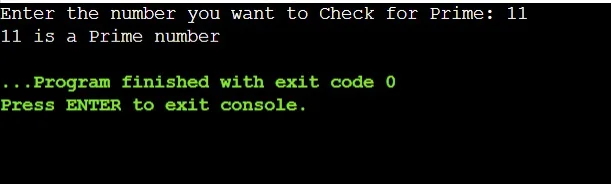
Check the C program code in the table below to check whether the given number is prime or not. Let's see C programming examples with output.| C Program to check Prime number Using Loop |
| #include <stdio.h> int main() { int i, num, temp = 0; // read input from user. printf("Enter the number you want to Check for Prime: "); scanf("%d", &num); // Run loop for num/2 for (i = 2; i <= num / 2; i++) { // check if given number is divisible by any number. if (num % i == 0) { temp++; break; } } // check for the value of temp and num. if (temp == 0 && num != 1) { printf("%d is a Prime number", num); } else { printf("%d is not a Prime number", num); } return 0; } |
Output
C Program Algorithm to Check Prime Number Using Functions
Check the algorithm for using the function to check whether a given number is prime or not.- Step 1: Define a function which accepts an integer number as a parameter.
- Step 2: First, initialize a variable temp with 0.
- Step 3: Now iterate the loop from 2 to n/2.
- Step 4: If the given number is divisible by a loop iterator, then increment the temp value.
- Step 5: Now, check if the value of temp returned is 0. If it is 0 then return “Given number is Prime”
- Else,
- return “The given number is not a prime number.”
C Program Implementation to Check Prime Number Using Function
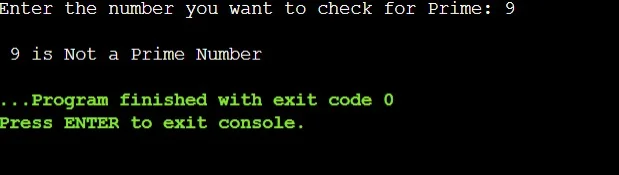
Check the code below in the table to check whether the given number is prime. Dive into c programming examples with output.| C Program Code to Check Prime Number Using Function |
| #include <stdio.h> // Function is used to check whether the number given is prime or Not int is_Prime(int num) { int i, temp = 0; // iterate up to num/2. for (i = 2; i <= num / 2; i++) { // if num has factors, // update temp. if (num % i == 0) { temp++; } } return temp; } int main() { int num, temp = 0; printf("Enter the number you want to check for Prime: "); scanf("%d", &num); // Calling function temp = is_Prime(num); if (temp == 0 && num != 1) { printf("\n %d is a Prime Number", num); } else { printf("\n %d is Not a Prime Number", num); } return 0; } |
Output
C Program Algorithm to Check for Prime Using Recursion
This is an algorithm to check whether a given number is prime or not using recursion.- Step 1: Define a recursive function which accepts an integer as a parameter, say num.
- Step 2: Intialize the value of i with “2”/
- Step 3: Now, decide the base condition of the function. When the num value is equal to 0 or 1, the return is false.
- Step 4: If the num value is equal to i then return true.
- Step 5: If the num value is equal to i then return true.
- Step 6: If the number is divisible by i then return false and increment i.
- Step 7: Keep calling the function recursively until it reaches the base value.
C Program Implementation for Prime Number Using Recursion
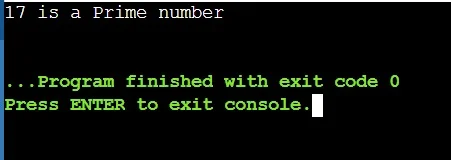
Check the code below for the implementation of the prime number checker function using the recursion function.| C Program to Check for Prime Number Using Recursion |
| #include <stdio.h> #include <stdbool.h> // Recursive function to check for prime number bool is_Prime(int num) { static int i = 2; // Base Case if (num == 0 || num == 1) { return false; } // Recursive Case if (num == i) return true; // check if num is divisible by any number if (num % i == 0) { return false; } i++; // recursive function call. return is_Prime(num); } int main() { // test case 1 int num = 20; if (is_Prime(num)) { printf("%d is a Prime number\n", num); } else { printf("%d is not a Prime number \n", num); } } return 0; } |
Output
C Program Algorithm to Check for Prime Number using Sieve of Eratosthenes
The Sieve of Eratosthenes is an efficient way of finding all prime numbers smaller than a given number n when n is smaller than 10 million or so. Given below is the algorithm to check for Prime numbers using the Sieve of Eratosthenes.- Step 1: Make an array of type boolean is_Prime[] and itntialize all its indexes with a value of 1 or true.
- Step 2: Start with the first number, which will be 2.
- Step 3: Iterate over each number from 2 to the square root of n.
- Step 4: For each prime number, mark its multiples as non-prime in the array of is_Prime.
- Step 5: The numbers in the array that are still true are prime numbers. Now return i.
C Program Implementation to Check for Prime Number using Sieve of Eratosthenes
Check the code below for implementation of Sieve of Eratosthenes in the table below.| C Program to Check for Prime Number using Sieve of Eratosthenes |
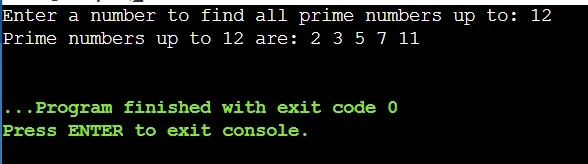
| #include <stdio.h> #include <stdbool.h> void sieve_of_eratosthenes(int n) { // Create a boolean array with all values marked as true bool is_prime[n+1]; for (int i = 0; i <= n; i++) { is_prime[i] = true; } // Start with the first prime number, which is 2. for (int p = 2; p * p <= n; p++) { // If is_prime[p] is not changed, then it is a prime if (is_prime[p] == true) { // Update all multiples of p to not prime for (int i = p * p; i <= n; i += p) { is_prime[i] = false; } } } // Print all prime numbers printf("Prime numbers up to %d are: ", n); for (int p = 2; p <= n; p++) { if (is_prime[p]) { printf("%d ", p); } } printf("\n"); } int main() { int n; printf("Enter a number to find all prime numbers up to: "); scanf("%d", &n); sieve_of_eratosthenes(n); return 0; } |
Output
Learn C Programming Online: Resources
You can learn C programming online via:- TutorialsPoint
- GeeksforGeeks
- CodeChef
- HackerRank
- Coursera & edX
- PW Skills
Learn Data Structure in C++ with PW Skills
If you want to sharpen your Data Structures and Algorithms for a Software developer role, then start your transformation journey with our Decode C++ with DSA Course and master C++ programming along with major DSA Concepts. Get more than 100+ hours of learning materials, all covered by industry-level experts. Have access to the latest curriculum based on cutting-edge technologies with free PW Lab access, Q&A dashboard, industry-relevant project-based learning, certification and much more only at pwskills.com.



C Program for Prime Numbers FAQs
How do I find prime numbers from 1 to 100 using the C program?
We can use the Sieve of Eratosthenes to print prime numbers in a given range from a given prime number to a given value n.
How do you check whether a given number is prime or not?
If a number is divisible by itself or by 1, then it is said to be a prime number. We can use c program to find if a number is prime or not.
What are different ways of checking whether a number is prime or not?
We can use loops, functions, recursions and other methods to check whether a given number is prime or not.
What is the sieve of Eratosthenes in C?
The sieve of Eratosthenes is an algorithm to find all prime numbers in a segment from the given prime number to n. Check out more about the algorithm in this article.


Talk to a counsellorHave doubts? Our support team will be happy to assist you!



Get Free Counselling Today
and Clear up all your Doubts
Talk to Our Counsellor just by filling out the form.
Join 15 Million students on the app today!
 Live & recorded classes available at easeDashboard for progress trackingLakhs of practice questions

