
Java Logical Operators
 Aashutosh Dwivedi30 Mar, 2026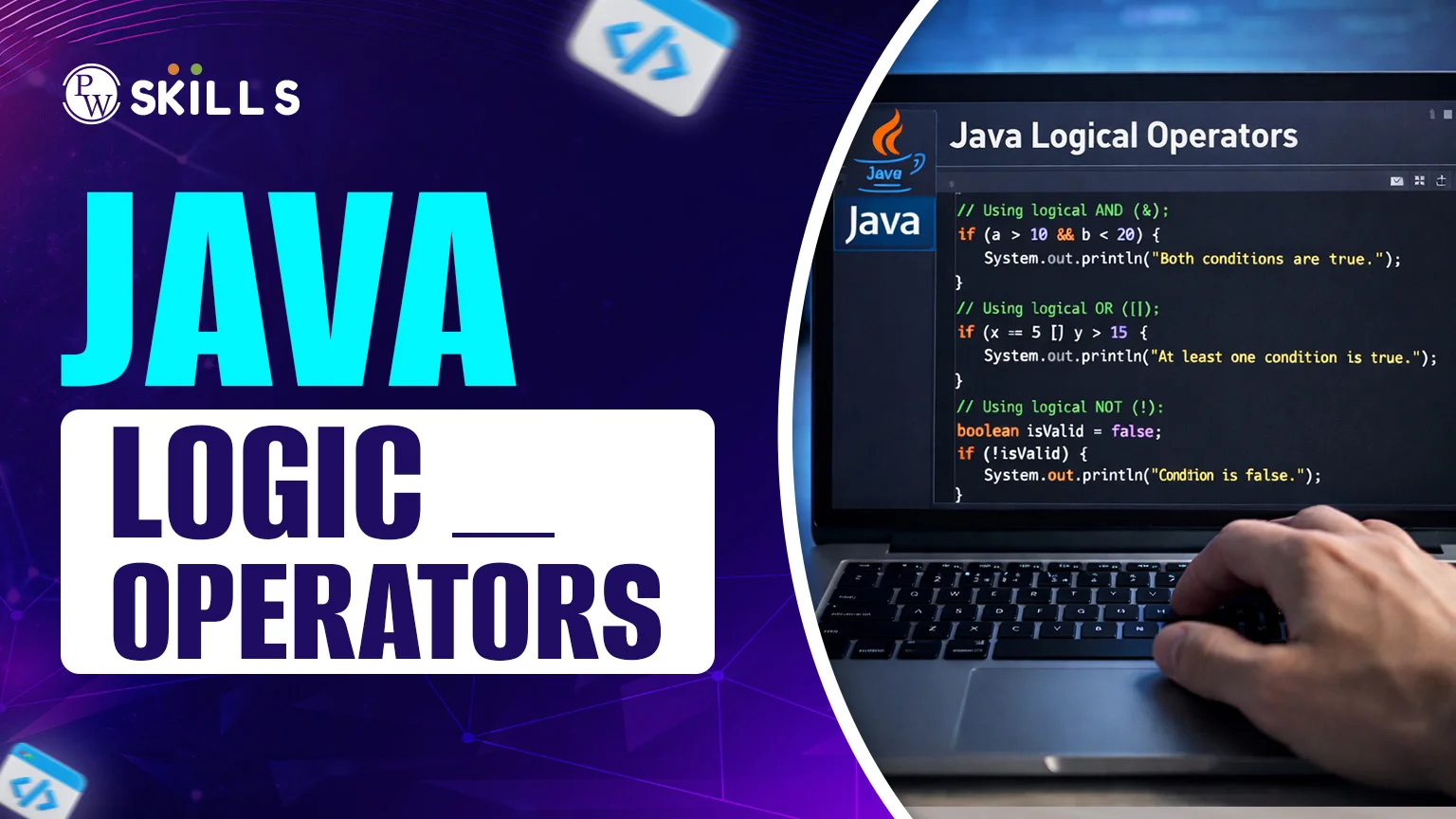
For a lot of students, the hardest part isn't creating code; it's getting the computer to "think" about more than one thing at a time. You are looking at the power of Java Logical Operators if you have ever wondered how a login system checks if both your username and password are right or how a game chooses if you win or lose. These operators hold your program's decision-making process together. It's not enough to merely pass an exam; you also need to know the details of how to write code that works well and professionally in a variety of situations.
What Are Java Logical Operators?
In the Java programming language, logical operators are used to determine the logic between variables or values. They primarily work with boolean data types, meaning they deal with "true" or "false" outcomes. When you are building a program, you use these symbols to connect two or more relational expressions or to flip the logic of a single expression. There are three main types of logical operators you need to master:- Logical AND (&&)
- Logical OR (||)
- Logical NOT (!)
Types of Java Logical Operators
To understand how these work in a real-world scenario, let's break down each operator with a clear example.1. Logical AND (&&)
The AND operator only returns true if both propositions are true. If even one side is wrong, the whole thing is wrong.- Syntax: expression1 && expression2
- Example: Think of a banking app as an example. You need a high enough balance and the right PIN to take out cash. If you have the money but the wrong PIN, the transaction won't go through.
2. Logical OR (||)
The OR operator is more adaptable. If at least one of the claims is true, it returns true. If both sides are false, it merely returns false.- Syntax: expression1 || expression2
- Example: If you are under 18 and have a student ID, you might be able to get a student discount. You get the discount if either of these things happens.
3. Logical NOT (!)
The NOT operator only acts on one value, which is why it is called a unary operator. It only flips the outcome. It makes things that are true false and those that are false true.- Syntax: !expression
- Example: !isGameOver. The logic returns true if the game is not over, which lets the player keep going.
|
Operator Name |
Symbol | Description | Practical Example (if x = 10) |
| Logical AND | && | Returns true if both statements are true. |
(x > 5 && x < 20) -> True |
|
Logical OR |
|| | Returns true if at least one statement is true. | (x > 15 || x == 10) -> True |
| Logical NOT | ! | Reverses the result (True becomes False). |
!(x == 10) -> False |
Short-Circuit Evaluation in Java Logical Operators
Short-circuiting is one of the most essential "pro-level" ideas. The "short-circuit" operators in Java are && and ||.- For &&: If the first condition is false, Java doesn't even look at the second one because the whole thing is guaranteed to be false anyway.
- For ||: If the first condition is true, Java skips the second one because the whole expression is already guaranteed to be true.
Also Read :
- Java Operator Precedence
- Java Assignment Operators
- Java Comparison Operators
- Java Arithmetic Operators
- Java Nested If Statements
- Java Booleans
- Top 5 Java Internships To Apply In April
- Top 30 Java Interview Question and Answers
Java Logical Operators Order of Precedence
Just like in mathematics, where multiplication comes before addition (BODMAS/PEMDAS), Java has a specific order of precedence. If you mix different operators in one line, Java follows this hierarchy:- Logical NOT (!): This has the highest priority and is evaluated first.
- Logical AND (&&): Evaluated after NOT.
- Logical OR (||): Has the lowest priority among the three.
Java Logical Operators Program Example
Let’s look at a practical program to see these concepts in action. You can copy this into your IDE to test how the logic flows. Java public class LogicDemo { public static void main(String[] args) { int age = 25; boolean hasLicense = true; boolean hasInsurance = false; // Using AND if (age >= 18 && hasLicense) { System.out.println("You are legally allowed to drive."); } // Using OR if (hasLicense || hasInsurance) { System.out.println("You have at least one valid document."); } // Using NOT if (!hasInsurance) { System.out.println("Warning: You do not have insurance!"); } } } In this example, the program checks multiple criteria to provide a specific output. This is the foundation of every interactive application.Common Mistakes in Logical Operators in Java
Even experienced developers sometimes trip up on logic. Here are a few things to keep in mind:- Confusing & with &&: In Java, a single & is a bitwise operator, while && is a logical operator. While they look similar, && is almost always what you want for conditional logic because of its short-circuiting property.
- Neglect of Precedence: Writing a || b && c is not the same as (a || b) && c. Because of precedence, the && will be evaluated before the ||.
- Overcomplicating NOT: Sometimes, using ! makes code harder to read. Instead of if (!(age < 18)), it is often cleaner to write if (age >= 18).
Logical Operators in Java: Key Takeaways
To wrap up the technical side, let's revisit the hierarchy. When you see a complex line of code, evaluate it in this order:- Parentheses () (Always first)
- Logical NOT !
- Arithmetic Operators (like +, -, *)
- Relational Operators (like >, <)
- Logical AND &&
- Logical OR ||



FAQs
What is the difference between && and || in Java?
The && (AND) operator only returns true if both criteria are true. The || (OR) operator just needs one of the requirements to be true in order to return true.
How does logical operator precedence in Java affect my code?
The precedence determines the order in which operators are evaluated. Since ! is evaluated before &&, and && is evaluated before || missing parentheses can lead to incorrect logic results.
Can I use logical operators in Java with integers?
No, Java's logical operators, such as && and ||, are only meant to work with boolean values. You would utilise bitwise operators (&, |) to do logical operations on bits of integers.
What is short-circuiting in logical operators in a Java program?
Short-circuiting is an optimisation where Java stops evaluating an expression as soon as the result is certain. For example, in an && operation, if the first part is false, the second part is skipped.
Where can I see a Java logical operators example in real projects?
You will see them everywhere! Common examples include checking if a user is logged in AND has admin rights or checking if a text field is empty OR contains invalid characters.